全方位学习中心
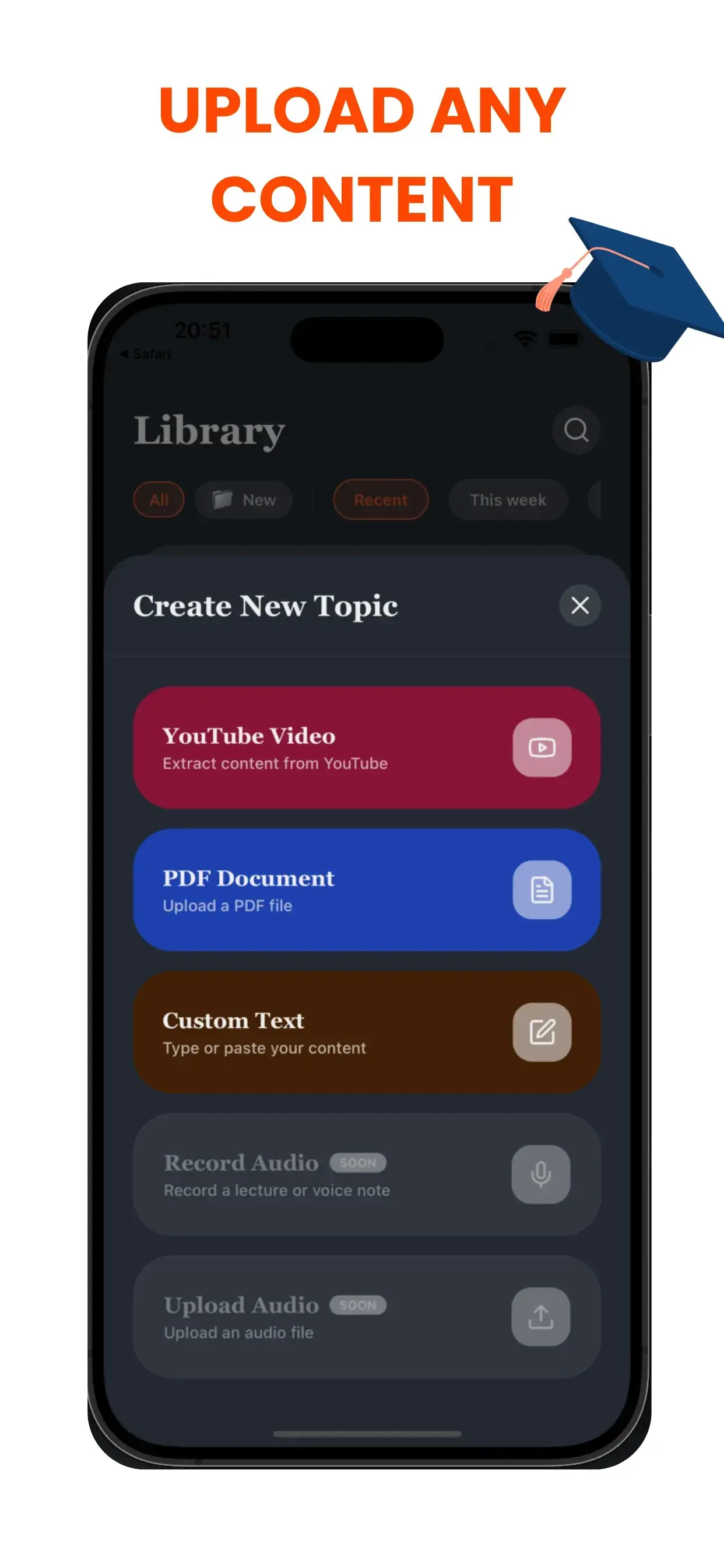
现代学生不仅仅从教科书中学习。你还会从播客、YouTube 教程、Zoom 讲座录音和手写讲义中学习。TikoNote 将这些分散的格式统一到一个核心知识库中。
高精度音频转录
用手机录下教授的讲课,之后让 TikoNote 负责整理笔记。我们的转录引擎以高精度将语音转换为文本,甚至能过滤掉口头语,然后将其整理成结构化的笔记。
YouTube 转笔记引擎
YouTube 实际上是世界上最大的教室。粘贴一个教育视频链接,TikoNote 会为你“观看”它。它提取转录稿、总结课程并生成练习题——你可以不用手动记笔记就掌握知识。
PDF、图片与文档
有课本页面的扫描件?一份幻灯片?TikoNote 使用 OCR 和文本提取技术从静态文件中抓取原始信息,并将其转化为互动的学习材料。
High-Accuracy Audio Transcription
Record your professor's lecture on your phone and let TikoNote handle the note-taking. Our transcription engine converts speech to text with high accuracy, even filtering out "umms" and "ahhs", then organizes it into structured notes.
YouTube-to-Notes Engine
YouTube is practically the world's biggest classroom. Paste a educational video URL, and TikoNote will "watch" it for you. It extracts the transcript, summarizes the lesson, and generates a quiz—so you can retain the information without creating custom notes manually.
PDF & Image & Documents
Have a scan of a textbook page? A slide deck? TikoNote uses OCR and text extraction to pull the raw information out of your static files and turns them into interactive study materials.
What is Multi-Modal Learning?
Multi-modal learning is the practice of engaging with the same content through multiple sensory and cognitive channels — reading, listening, visualising, and practising. Research including Mayer's Cognitive Theory of Multimedia Learning shows that processing information in multiple formats simultaneously improves long-term retention by up to 40% compared to single-format study.
TikoNote operationalises this by converting any single source — a PDF, recording, or video — into multiple output formats simultaneously: summary, flashcard deck, mind map, and practice quiz. One upload, every learning modality covered.
The Four Learning Channels TikoNote Covers
Visual (Mind Maps): Spatial representation of concept relationships — ideal for visual learners who grasp structure through diagrams and hierarchy.
Reading/Writing (Smart Summaries): Structured prose summaries preserving key arguments, definitions, and exam-relevant details.
Auditory (Audio Transcription): TikoNote processes lecture audio and recordings, bridging the gap between what you hear and what you study.
Kinaesthetic (Active Recall): Flashcards, quizzes, and Blurting exercises force active retrieval — the most effective of all study methods.
How to Build a Multi-Modal Study Session
- Upload your lecture file — PDF, audio, or YouTube link.
- Generate all four outputs — Summary + Flashcards + Mind Map + Quiz simultaneously.
- Start with the Mind Map — 5 minutes building a mental model of the topic structure.
- Read the Summary — fill in the details of each branch (10–15 mins).
- Drill Flashcards — active recall session to test key concept retention (15–20 mins).
- Take the Quiz — simulate exam conditions to identify remaining gaps (10–15 mins).
Frequently Asked Questions
- What file types does TikoNote support for multi-modal study?
- TikoNote accepts PDF, DOCX, PPTX, MP3, MP4, WAV, JPEG/PNG, and YouTube URLs — any format you receive course content in can be converted to all study output types.
- Can I generate multiple output types from one upload?
- Yes. Upload once and select all desired outputs — TikoNote generates summary, flashcards, mind map, and quiz without re-uploading.
- Does multi-modal learning actually improve exam scores?
- Studies consistently show it does. Mayer's research found dual-channel processing improves transfer test performance by 23–42% over single-channel methods.
- Is TikoNote suitable for auditory learners?
- Yes. TikoNote processes audio recordings and YouTube lectures, extracting content auditory learners received during a lecture into all study formats.
- Can I use TikoNote for group study?
- Yes. Share generated notes, mind maps, and flashcard sets via link. Study groups can start with a shared mind map session before each member drills their own flashcard review.