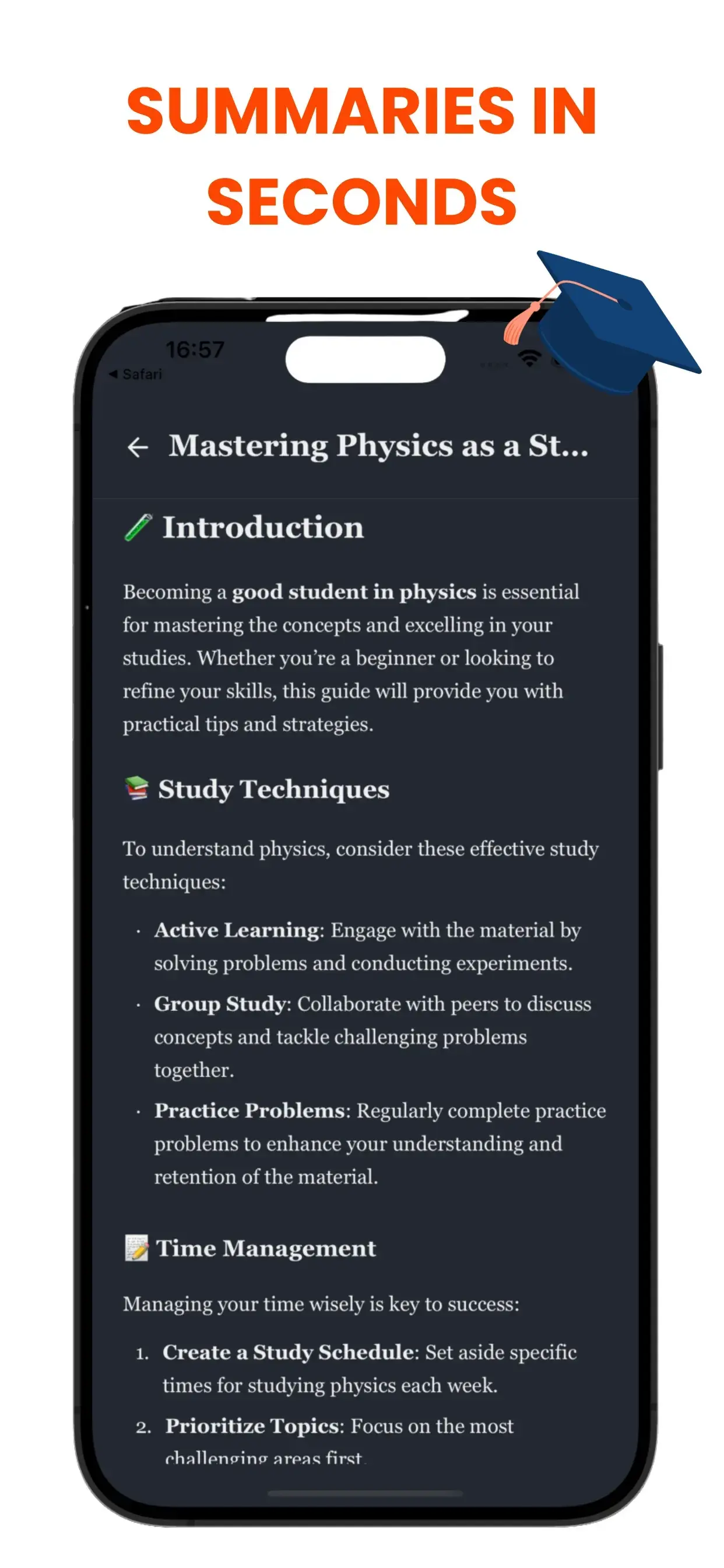
效率就是生产力
在学术世界里,信息过载是常态。你不可能完整读完每一份指定的读物。智能摘要让你能够快速消化大量信息,而不会错过关键点。
我们的 AI 摘要如何工作
TikoNote 使用先进的大语言模型 (LLMs) 来理解你的上下文内容。它不仅仅是剪裁句子;它将信息合成:
- 执行摘要: 对主要论点的高层次概述。
- 核心要点: 你必须记住的 3-5 个最重要的点。
- 详尽列表: 详细的配套事实和数据。
实际应用
- 讲座复习: 将一小时冗长的讲座浓缩为 5 分钟的精华阅读。
- 研究论文: 立即理解复杂 PDF 的摘要、方法论和结论。
- 缺课补课: 通过总结朋友的录音或笔记,快速跟上进度。
How Our AI Summarization Works
TikoNote uses state-of-the-art Large Language Models (LLMs) to read and understand your content contextually. It doesn't just chop sentences; it synthesizes information into:
- Executive Summary: A high-level overview of the main thesis.
- Key Takeaways: The 3-5 most important points you must remember.
- Bullet Points: detailed supporting facts and data.
Real-World Applications
- Lecture Review: condense an hour-long rambling lecture into a clean 5-minute read.
- Research Papers: Understand the abstract, methodology, and conclusion of complex PDFs instantly.
- Missed Classes: Catch up on what you missed by summarizing a friend's recording or notes.
The Problem with Long-Form Content
The average university lecture contains 6,000–8,000 words of spoken content. A standard textbook chapter runs 5,000–15,000 words. Passive re-reading of this volume is one of the least effective study strategies according to cognitive science research. TikoNote's Smart Summaries extract the core concepts, key arguments, and critical details from any document — producing a structured, scannable summary in 30–90 seconds.
What Makes a Summary "Smart"
Standard summarisation tools truncate content or extract the first few sentences. TikoNote's AI uses semantic understanding to identify:
- Key arguments — the central claims the author or lecturer is making
- Supporting evidence — data, examples, and case studies backing each argument
- Definitions — technical terms and their precise meanings
- Relationships — how concepts connect, contrast, or build on each other
- Exam-relevant details — dates, statistics, names, and formulas that typically appear in assessments
Smart Summaries for Different Use Cases
Pre-lecture prep: Upload a textbook chapter before class. Read the 400-word summary in 3 minutes to arrive with context.
Post-lecture consolidation: Generate a summary of your lecture notes immediately after class while memory is fresh.
Exam revision: Generate summaries of all lecture notes for a module. Use them as rapid review sheets the night before your exam.
Research papers: Summarise academic papers to quickly assess relevance before reading in full — saving hours during literature reviews.
Frequently Asked Questions
- How long are TikoNote's Smart Summaries?
- Summary length scales with source length. A 20-slide lecture typically produces a 300–500 word summary. A 50-page chapter produces 800–1,200 words. You can set a custom target length.
- Can TikoNote summarise YouTube videos?
- Yes. Paste any YouTube link and TikoNote transcribes the audio and produces a structured summary of the video content.
- Does Smart Summary work in multiple languages?
- Yes. TikoNote processes source material in 12+ languages and generates summaries in the same language as your content.
- Can I generate a summary and flashcards from the same document?
- Yes. Upload once and generate a summary, flashcard deck, mind map, and quiz from the same file without re-uploading.
- How is TikoNote's summary different from ChatGPT's?
- TikoNote is purpose-built for study. Summaries are structured for exam relevance — preserving definitions, data, and relationships that generic AI summarisers often drop.
