
10 Science-Backed Study Techniques That Actually Work (And 3 That Don't)
Not all study advice is created equal. Some techniques feel intuitive and productive — and don't work. Others feel uncomfortable and slow — and are the most effective methods available.
This guide is based on cognitive science research, not popular opinion. The comprehensive 2013 review by Dunlosky et al. rated 10 common study techniques on utility. We've combined those findings with subsequent research to give you a complete picture of what actually works.
The 3 Popular Techniques That Don't Work (Well)
Before the good news, here's what to stop doing — or at least stop relying on.
❌ 1. Re-Reading
The problem: Re-reading creates familiarity, not recall. The material flows easily because you recognize it — not because you know it. When you sit down to recall it from memory, the recognition disappears.
The research: Dunlosky et al. (2013) rated re-reading as low utility. Multiple studies show it produces minimal long-term retention benefit over a single reading.
What to do instead: Active recall (technique #1 below).
❌ 2. Highlighting and Underlining
The problem: Highlighting requires almost no cognitive effort. It creates the illusion of engagement (you're doing something) while producing nearly zero memory benefit.
The research: Rated low utility by Dunlosky et al. No consistent improvement over not highlighting at all.
What to do instead: Instead of highlighting, pause and write a question about what you just read. Answer it later without looking. That's active recall.
❌ 3. Summarizing
The problem: Summarizing has marginal utility — slightly better than highlighting. But for most students, it produces passive paraphrase rather than genuine comprehension.
The research: Rated low utility overall by Dunlosky, though it has moderate value for students who are skilled summarizers.
What to do instead: Explain the concept in your own words as if teaching it. That's the Feynman Technique — and it's dramatically more effective.
The 10 Techniques That Actually Work
✅ 1. Practice Testing (Active Recall)
Utility rating: HIGH
Testing yourself on material — answering questions, explaining from memory, taking practice exams — is one of the highest-utility study techniques available. The testing effect is one of the most robust findings in educational psychology.
How to implement:
- Close your notes after reading. Write everything you remember.
- Use flashcards (answer before flipping)
- Take practice exams under timed conditions
- Use TikoNote's AI quiz generator to practice from your own notes
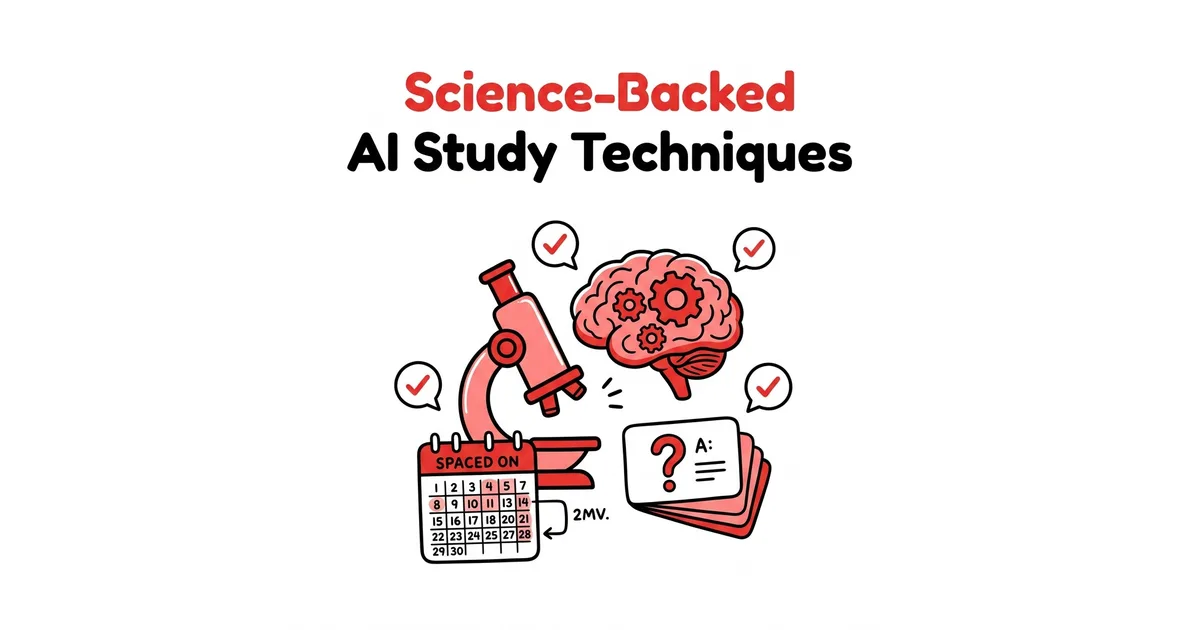
✅ 2. Distributed Practice (Spaced Repetition)
Utility rating: HIGH
Studying the same material across multiple sessions separated in time produces far better long-term retention than the same amount of study in one block.
How to implement:
- Review material at 1, 3, 7, 14, 30-day intervals
- Use a spaced repetition app to automate scheduling
- Never rely on a single study session for any topic you need to retain
See: Spaced Repetition Explained
✅ 3. Interleaved Practice
Utility rating: MODERATE-HIGH
Instead of studying all of Topic A, then all of Topic B, interleave them: A, B, A, B. This makes each practice session harder (you can't rely on momentum from the previous question) but produces better long-term discrimination between concepts.
How to implement:
- Mix problem types when practicing math or physics
- Alternate between topics when building flashcard review sessions
- Don't block-study by chapter exclusively
✅ 4. Elaborative Interrogation
Utility rating: MODERATE
Ask "why" and "how" about every fact you're learning. "Sodium is a metal" → "Why is sodium a metal? What properties make it metallic? Why is it in Group 1?"
This forces you to connect new information to existing knowledge — which is what creates durable, transferable memory.
How to implement:
- After reading any new fact, ask: "Why is this true? What would happen if it weren't?"
- Use this during lecture review to convert passive notes into active questions
✅ 5. The Feynman Technique
Utility rating: HIGH (evidence-based components)
Explain a concept in plain language from memory. Find where you can't explain it clearly. Go back and fill those gaps. Build an analogy. This method combines retrieval practice with elaborative interrogation and self-explanation — three independently effective techniques.
How to implement: See What Is the Feynman Technique? and How to Apply It to Any Subject.
✅ 6. Self-Explanation
Utility rating: MODERATE
Explain to yourself why each step in a process makes sense, rather than accepting it passively. Different from summarizing — you're explaining the reasoning, not just the content.
Research: Chi et al. (1989) showed that students who self-explained as they read textbooks significantly outperformed those who didn't on transfer tests.
How to implement: As you read, pause after each paragraph: "Why does this follow from what came before? What's the reasoning here?"
✅ 7. Concrete Examples
Utility rating: MODERATE
Abstract concepts are far more memorable when anchored to concrete examples. Each example provides an additional retrieval path to the underlying concept.
How to implement:
- For every abstract principle you learn, generate at least two concrete examples
- Prefer examples from your own experience or context
- Challenge yourself to find counter-examples too — they reveal the limits of the concept
✅ 8. Dual Coding (Text + Visuals)
Utility rating: MODERATE
Combining verbal information with visual representation — diagrams, mind maps, timelines — creates two memory traces for the same information, improving retrieval.
How to implement:
- Draw diagrams of processes after reading about them
- Create timelines for historical sequences
- Use mind maps for topic overviews (from memory, not from notes)
✅ 9. Pre-Testing (Before Learning)
Utility rating: MODERATE
Attempting to answer questions about material before you've studied it — even though you'll mostly get it wrong — primes your brain for the correct information. Research by Richland et al. shows that pre-testing improves learning of the correct answer compared to no pre-testing.
How to implement:
- Look at end-of-chapter questions before reading the chapter
- Try to define key terms from headings before reading the section
- Attempt past exam questions before starting your study of that topic
✅ 10. Sleep and Consolidation
Utility rating: HIGH (often ignored)
Sleep is when the brain consolidates memories from short-term to long-term storage. Walker's research on sleep and memory shows that sleep-deprived students retain dramatically less from the same study session than rested ones.
How to implement:
- Study in the evening; sleep fully; review in the morning
- Never sacrifice sleep to study more — the trade-off is almost always negative
- Naps after intensive study sessions meaningfully improve retention
Building a Study System from the Evidence
The highest-impact combination:
- Feynman Technique on first encounter (deep encoding)
- Active recall during each subsequent session (retrieval practice)
- Spaced repetition to schedule those sessions optimally
- Interleaving across topics within sessions
- Sleep before and after intensive study
This isn't 10 separate things to do — it's one integrated system. Tools like TikoNote automate the active recall and spaced repetition components, making the system consistent without requiring manual effort.
Frequently Asked Questions
Which is the single most effective study technique?
Practice testing (active recall) and distributed practice (spaced repetition) are consistently rated highest. If you can only implement one thing, start with closing your notes and writing everything you remember about a topic after each study session.
Do these techniques work differently for different subjects?
The core mechanisms work universally, but application varies. STEM benefits particularly from interleaving and concrete examples. Languages benefit particularly from distributed practice and dual coding. Humanities benefit from elaborative interrogation and self-explanation.
How long to see results?
Active recall produces immediate improvement in next-day retention. Spaced repetition benefits compound over 2–6 weeks. The Feynman Technique shows benefits on the next exam in the subject. Full system benefits peak after a full semester of consistent use.
Should I use all 10 techniques?
Not all at once. Start with active recall and spaced repetition — they have the highest impact per time invested. Add the others as your system matures. See How to Study Smarter, Not Harder for a prioritized implementation guide.
Is there research on AI study apps specifically?
AI tutoring systems have strong research support. Apps that implement active recall and spaced repetition automate the highest-utility techniques — making them more accessible and consistent for students who wouldn't implement them manually.
The Bottom Line
The techniques that feel hardest — testing yourself, spacing your reviews, explaining concepts without your notes — are the ones that work. The techniques that feel most productive — re-reading, highlighting, organizing notes — largely don't.
The evidence is clear. The implementation is a choice. Start with active recall today — it's the highest-leverage change you can make to your study routine.
Put this into practice — right now.
Upload a PDF, lecture slide, or YouTube link. TikoNote instantly generates quizzes, flashcards, and a Feynman session from your own material — not generic internet content.
- ✓ Works on any PDF, video, or audio
- ✓ Active recall built-in — not passive summaries
- ✓ Used by 50,000+ students

Written by TikoNote Team
AI learning researchers & cognitive science enthusiasts building tools that help students study smarter with evidence-based methods like active recall, spaced repetition, and the Feynman Technique.