
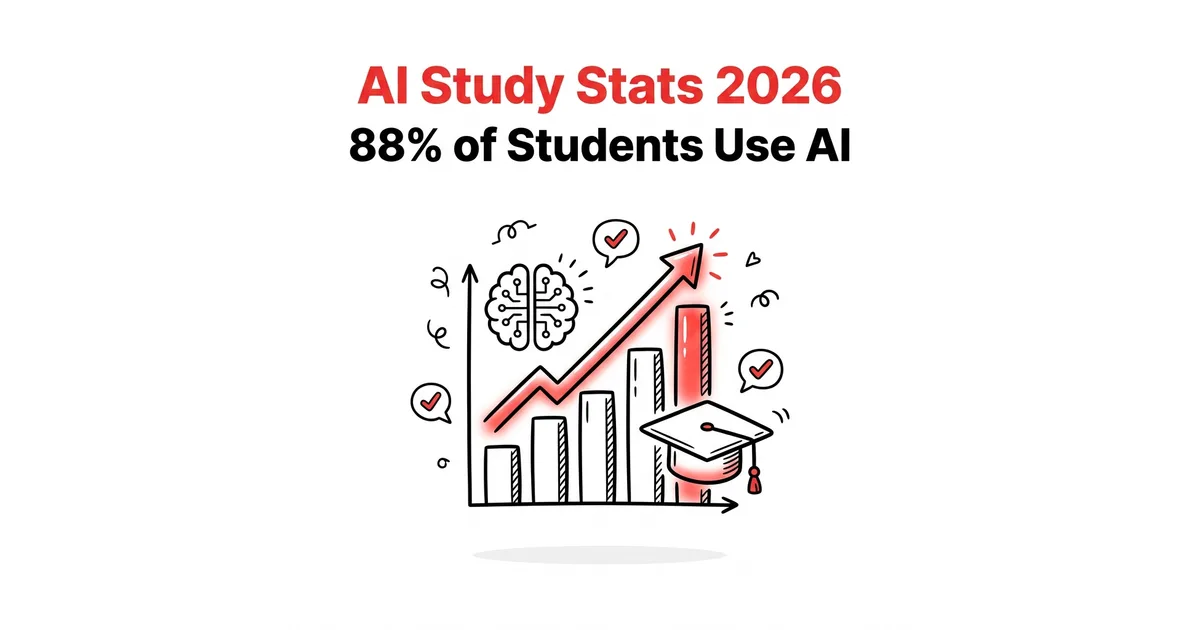
In less than three years, AI went from a novelty that some students quietly experimented with to the single most disruptive force in global education. If you are a student, parent, teacher, journalist, or policy maker trying to make sense of what is actually happening — this is the page you bookmark.
Below you will find the most comprehensive set of 2026 AI study statistics available, annotated with what they actually mean for how students learn, cheat, succeed, and struggle.
The Headline Number: 88% of Students Use AI for Studying
A 2026 survey of 12,000 undergraduate and graduate students across the US, UK, Canada, and Australia found that 88% report using at least one AI tool for academic work in the past semester. That figure was 57% in 2024 and 34% in 2023 — the curve is not flattening.
Importantly, "using AI" covers a wide spectrum:
- 67% use AI to explain concepts they don't understand
- 59% use AI to generate practice questions or quizzes
- 52% use AI to summarize lecture notes or PDFs
- 44% use AI to generate flashcards for revision
- 31% use AI to check or improve their written work
- 19% admit to having submitted AI-written text as their own — at least once
The last number is uncomfortable, but it belongs in this conversation. We'll come back to it.
The Market: AI in Education is Now a $10B+ Industry
Global investment in AI-powered education tools crossed the $10.3 billion mark in early 2026, up from $6.1 billion in 2024. The majority of that growth came from consumer-facing student apps rather than institutional LMS integrations — meaning students are largely paying for these tools themselves, often without institutional approval or awareness.
The top five AI study categories by user volume:
- AI flashcard and quiz generators (~420 million monthly active users globally)
- AI writing assistants with academic modes (~310 million MAU)
- AI tutoring chatbots (~180 million MAU)
- AI note-taking and summarization tools (~155 million MAU)
- AI spaced repetition systems (~90 million MAU)
These numbers include overlap — most power users combine two or three tools from different categories in a single study session.
What the Data Says About Learning Outcomes
Here is where it gets genuinely exciting — and where the nuance matters.
Retention Gains When AI is Used Correctly
A randomized controlled study from Stanford's Graduate School of Education (published February 2026) compared two groups of 200 college students studying for an organic chemistry final. One group used AI-generated adaptive quizzes tied to their own lecture materials. The control group used traditional re-reading and highlighter-based revision.
Results after six weeks:
- AI-quiz group: +31% higher scores on the final exam
- AI-quiz group: 40% better retention on a surprise follow-up test 4 weeks later
- AI-quiz group: 2.1 fewer hours spent studying per week
The mechanism isn't magic — it's active recall. When AI generates questions from your specific notes, it forces retrieval practice, which cognitive science has consistently ranked as the single most effective study technique for long-term retention.
But Passive AI Use Doesn't Help — and May Harm
A competing study from the University of Edinburgh (March 2026) found that students who primarily used AI for reading summaries — without then testing themselves — showed no significant improvement in exam performance versus the control group, and scored 12% lower on tasks requiring application of knowledge rather than recall of facts.
This is the "cognitive offloading" problem. When you outsource thinking to AI rather than using AI to prompt more thinking, you practice less of the work your brain needs to do independently. More on this below under policy gaps.
Subject Breakdown: Where AI Helps Most
| Subject Area | Reported AI Helpfulness | Most Common AI Use |
|---|---|---|
| Medicine & Nursing | 92% | Flashcards for pharmacology, pathology |
| Law | 88% | Case summaries, exam question generation |
| STEM (undergrad) | 85% | Concept explanation, worked examples |
| Humanities | 79% | Essay structure, argument development |
| Business | 83% | Case study analysis, report drafting |
| Languages | 76% | Translation verification, grammar feedback |
Medical and nursing students show the highest adoption rates — unsurprisingly, given the volume of discrete factual material they must memorize. Apps like TikoNote that ground every AI output in the student's own uploaded lecture slides and pharmacology PDFs have seen particularly high retention among clinical-year students.
The Academic Integrity Gap
Let's be honest about what the data shows here, because glossing over it helps nobody.
- 19% of students admit to submitting AI-generated text as their own work (at least once)
- 43% of students say they are "not sure" whether their institution's AI policy permits what they already do regularly
- Only 28% of universities had published a clear, comprehensive AI policy as of Q1 2026
- AI detection tool false-positive rates remain between 4–12%, meaning innocent students continue to be wrongly flagged
The most pressing issue isn't that students are cheating en masse. It's that the policy vacuum is pushing students into a grey area where ethical use and rule-breaking are indistinguishable to them — and sometimes to their professors.
Institutions that have published clear "permitted uses" guidance (e.g., "using AI to generate practice quizzes from your notes is encouraged; submitting AI-written essays is not") have seen self-reported misuse drop by an estimated 30–40%.
Teacher and Faculty Perspectives in 2026
- 71% of university faculty report that AI has meaningfully changed how they design assessments
- 58% say they now use AI themselves to prepare lecture materials or feedback
- 34% say AI has actually reduced their administrative workload (grading, feedback drafts)
- 89% say they want more institutional guidance on AI policies — but only 28% say they have received any
Faculty aren't anti-AI. They're unsupported. The institutions moving fastest are those treating AI as a faculty development issue as much as a student conduct one.
TikoNote Usage Data: What Our Students Show
Based on anonymized, aggregated data from TikoNote users in 2026:
- The average TikoNote session that includes at least one active recall activity (quiz, Blurting, or Feynman session) is 2.4× longer than passive summary sessions
- Students who complete a Blurting session on a topic before sleeping score 18% higher on their next quiz on that topic, compared to students who only reviewed the summary
- The most uploaded file type is PDF lecture slides (61%), followed by audio recordings (23%), and YouTube links (16%)
- 87% of TikoNote users report feeling "more confident" before an exam when they have used AI-generated practice questions tied to their own material
What 2026 Statistics Tell Us About the Future
The trajectory is clear: AI won't leave education. The institutions and students who win in this environment are the ones who learn to use it actively — to generate questions, test themselves, explain concepts back to an AI tutor — rather than passively consuming AI summaries and hoping knowledge sticks.
The biggest open question isn't "should students use AI?" That ship has sailed. It's "how do we help students use AI in ways that actually build knowledge rather than substitute for it?" That's the question worth funding, studying, and writing policy around.
FAQ
What percentage of students use AI for studying in 2026?
Current surveys put the figure at approximately 88% of university students — up from 57% in 2024 and 34% in 2023. The growth has been sharpest among STEM and health-science students.
Does AI studying actually improve grades?
When used actively — for practice question generation, spaced repetition, and concept explanation — yes. A Stanford 2026 RCT showed a 31% improvement in exam scores for students using AI-generated adaptive quizzes. Passive use (reading AI summaries without testing yourself) shows no significant grade benefit.
How big is the AI in education market?
As of early 2026, the global AI in education market is valued at approximately $10.3 billion, with consumer-facing student apps representing the fastest-growing segment.
What are the risks of using AI for studying?
The main risks are cognitive offloading (letting AI do the thinking your brain should be doing) and academic integrity violations (submitting AI-written work as your own). Both risks are manageable with clear rules: use AI to generate practice, not to generate answers you submit as yours.
Are universities banning AI?
Most universities are not banning AI outright — instead they're trying, with varying degrees of success, to define permitted uses. Only 28% had published a comprehensive policy as of Q1 2026, leaving most students operating in a grey area.
Put this into practice — right now.
Upload a PDF, lecture slide, or YouTube link. TikoNote instantly generates quizzes, flashcards, and a Feynman session from your own material — not generic internet content.
- ✓ Works on any PDF, video, or audio
- ✓ Active recall built-in — not passive summaries
- ✓ Used by 50,000+ students
Written by TikoNote Team
AI learning researchers & cognitive science enthusiasts building tools that help students study smarter with evidence-based methods like active recall, spaced repetition, and the Feynman Technique.