
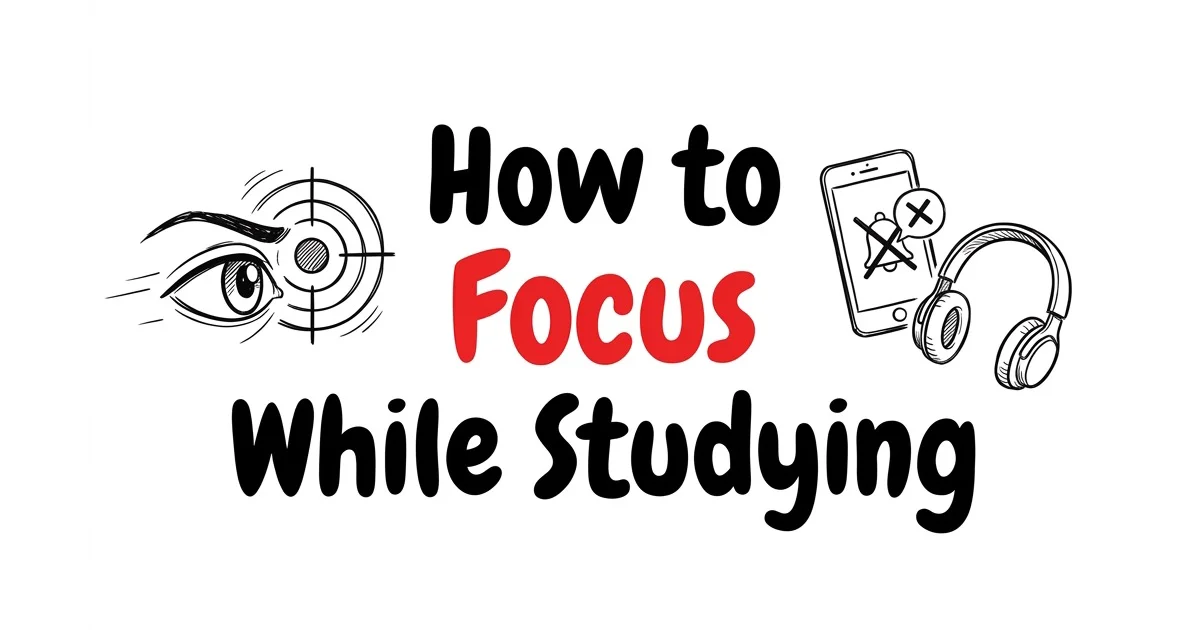
How to Focus While Studying: 9 Science-Backed Strategies to Eliminate Distraction
Inability to focus while studying isn't a character flaw — it's a predictable outcome of studying in an environment optimized for distraction, using methods that require sustained attention to low-engagement material.
Fix the environment and the method. Focus follows.
Why Modern Students Struggle to Focus
The human attention system evolved to prioritize novelty and threat — which is why a new notification or sound immediately captures attention. Your phone, every social media app, and every open browser tab are designed by teams of engineers to exploit this system.
The problem isn't willpower. If your phone is within reach and notifications are enabled, your attention system will be captured repeatedly, regardless of how much you want to study. Every interruption — even if you don't respond — breaks concentration and requires 15–23 minutes to fully restore, according to research by Gloria Mark at UC Irvine.
One hour of truly focused study beats three hours of distracted study for both learning and time efficiency.
Strategy 1: Phone in Another Room (Not on Silent)
This is the most impactful single change you can make. Research consistently shows that even the presence of a phone face-down on a desk reduces available cognitive capacity — your brain allocates resources to actively ignoring it.
Silent isn't enough. Out of reach is the minimum; out of the room is optimal.
Use Forest app or Screen Time limits if you must keep your phone nearby. But the best implementation is the simplest: walk it to another room when studying starts.
Strategy 2: Work in Defined Blocks (Pomodoro Technique)
Open-ended study sessions ("I'll study until I'm done") create anxiety that competes with focus. Defined blocks create a clear endpoint, which paradoxically makes sustained attention within the block easier.
The Pomodoro technique:
- 25 minutes: focused study (one task only)
- 5-minute break: move, hydrate, not social media
- Every 4 rounds: 15–20 minute longer break
Adapt block lengths to your attention capacity. Start with 15 minutes if 25 is too long. Build up over 2–3 weeks.
Strategy 3: Use Active Study Methods (Engagement Prevents Distraction)
The most effective distraction prevention is making studying inherently engaging.
Re-reading is cognitively passive — your attention system has no reason to stay on the page. Active recall — answering questions, explaining from memory, solving problems — requires active cognitive engagement that naturally suppresses the urge to seek distraction.
The practical test: Notice that you rarely get distracted while taking a test. That's because testing is engaging. Make your study sessions look more like tests.
See: Active Recall vs Passive Review
Strategy 4: Strategic Use of Background Music
Research on background music and concentration is mixed, with important nuances:
Helps focus (use for studying):
- Instrumental music without lyrics (classical, lo-fi, jazz)
- Nature sounds (brown noise, rain, coffee shop ambience)
- Neuro-acoustic audio (Focus@Will)
- Music you know well (doesn't capture attention by being novel)
Harms focus (avoid during active studying):
- Music with lyrics (verbal content competes with language-based tasks)
- New music you don't know (novelty captures attention)
- Highly variable tempo/rhythm (distracting)
For heavy cognitive tasks (writing, problem-solving, Feynman sessions): silence or white noise is usually optimal. Music is better for lower-cognitive review tasks.
Strategy 5: Environment Design Over Willpower
Design your study environment to make focus the default and distraction require effort.
Effective study environment:
- Designated study space (library, desk, coffee shop — not bed or couch)
- Only tools needed for the task are visible
- Website blocker running (Freedom, Cold Turkey, Focus mode)
- Door closed if studying at home
- Notifications completely off, not just silenced
The principle: Make the right behavior easy and the wrong behavior hard. If distraction requires effort (phone in another room, social media blocked), you'll drift into it far less.
Strategy 6: Clear Task Definition Before Starting
Vague study intentions ("I'll study economics for 2 hours") produce unfocused sessions. Specific task definition produces measurable progress.
Before each study block, write down:
- Exactly what you will do (not "study chapter 5" but "active recall on concepts 1–3 from chapter 5, then Feynman on the most confusing concept")
- What success looks like (can explain all 3 concepts without notes)
- When you'll stop (timer set for 25 minutes)
This eliminates the decision-making during the session that creates mental wandering. You know exactly what you're doing. You do it.
Strategy 7: Study During Your Peak Alertness Window
Most people have a 90–120 minute window of peak cognitive performance — for most, this is mid-to-late morning (9am–12pm), though night owls peak in late evening.
Scheduling your most demanding study tasks (active recall on complex material, Feynman sessions, problem sets) during this window produces more output for the same time investment. Save low-demand tasks (spaced repetition card review, organizing notes) for low-alertness periods.
How to find your window: For one week, note the times when thinking feels sharpest and most fluid. That's your peak. Protect it for your most important cognitive work.
Strategy 8: Physical Movement Before and During Study
Exercise and cognitive performance research consistently shows that aerobic exercise improves working memory, executive function, and sustained attention — all critical for focused study.
Practical implementations:
- 20-minute walk before a study session (improves focus for 2–3 hours after)
- Brief movement during breaks (5-minute walk, stretching, pushups) — prevents cognitive fatigue accumulation
- Don't go from bed directly to study desk — physical activation primes mental activation
For students who struggle with focus, exercise is one of the most underutilized and consistently effective interventions available. Also see How to Study With ADHD for focus strategies specifically for ADHD learners.
Strategy 9: Manage Your Energy, Not Just Your Time
Fatigue makes concentration nearly impossible. Managing energy throughout the day is as important as managing time.
Energy management for students:
- Sleep 7–8 hours (non-negotiable — sleep deprivation reduces cognitive performance more than almost any other factor)
- Don't schedule demanding study sessions immediately after heavy meals
- Caffeine has a 6-hour half-life — late afternoon coffee affects sleep quality, which affects next-day focus
- Hydration: even mild dehydration measurably impairs cognitive performance
The students who study most efficiently aren't the ones who push through fatigue — they're the ones who manage their energy such that most study sessions happen at high alertness.
Building a Focus System: Putting It Together
A complete focus system for a typical 2-hour study session:
Pre-session (10 min):
- Phone in another room
- Website blocker activated
- Timer set (25 min first block)
- Task list written (exactly what this session covers)
- Optional: 10-minute walk
Session blocks:
- 25 min active study → 5 min break (move, not scroll) → 25 min active study → 5 min break → 25 min active study
Post-session:
- 10-minute active recall brain dump of the session's content
- Brief review of what needs more work
- Tomorrow's session plan written (removes decision-making friction for starting)
Total time: ~2 hours. Effective, focused, active study time: ~75 minutes. That 75 minutes of active recall beats 4 hours of passive, distracted re-reading in retention and exam performance.
TikoNote and Focus
TikoNote's AI quiz system creates a natural focus loop: question appears, you retrieve the answer, get immediate feedback, next question. This rapid feedback loop is one of the most effective ways to maintain attention during study sessions.
Upload your notes. Let TikoNote generate the questions. Focus on answering them.
👉 Try TikoNote — focused active recall in under 2 minutes
Frequently Asked Questions
How long does it take to build better focus habits?
Research on habit formation suggests most people develop stable new habits within 4–8 weeks of consistent practice. Focus habits specifically: 2 weeks of consistent Pomodoro sessions makes the 25-minute blocks feel natural. 4 weeks of phone-free studying makes focused sessions feel easier than distracted ones.
What if I can't focus no matter what I try?
Persistent inability to focus despite environmental modifications may indicate ADHD, anxiety, depression, or sleep disorders — all of which are treatable. If focus problems are significantly impacting academic performance despite genuine strategy attempts, speaking to a doctor or campus health services is worth considering.
Does multitasking work for studying?
No — research on multitasking consistently shows that what we perceive as multitasking is rapid task-switching, which degrades performance on both tasks. For studying specifically, any task-switching (phone checking, tab switching, responding to messages) resets the focus cycle and dramatically reduces learning.
Should I study with friends or alone?
Alone for focused active recall and deep learning. With others for accountability (body doubling), motivation, and teaching each other (which is the highest-engagement form of active recall). Mixed approach: individual work in shared space, occasional explanation/teaching.
Is caffeine useful for studying?
In moderation and with good timing, yes. Caffeine improves alertness, reaction time, and sustained attention. The key: consume it at consistent times (morning or early afternoon only), avoid amounts that produce anxiety (which impairs focus), and never use it as a substitute for sleep.
Focus Is a System, Not a Virtue
Students who focus well haven't won some character lottery. They've designed their environment, their methods, and their schedules to make focus the default state.
Every strategy above reduces the cognitive cost of staying on task. Implement even three of them this week. The difference in effective study time will be measurable.
Put this into practice — right now.
Upload a PDF, lecture slide, or YouTube link. TikoNote instantly generates quizzes, flashcards, and a Feynman session from your own material — not generic internet content.
- ✓ Works on any PDF, video, or audio
- ✓ Active recall built-in — not passive summaries
- ✓ Used by 50,000+ students

Written by TikoNote Team
AI learning researchers & cognitive science enthusiasts building tools that help students study smarter with evidence-based methods like active recall, spaced repetition, and the Feynman Technique.