Question Generator From Text: Test Yourself Instantly
Reading is not studying.
It’s a harsh truth, but it’s the reason so many students spend hours in the library and still fail their exams. You can read a chapter on macroeconomics three times, but unless you actively force your brain to retrieve that information, it will vanish by the next morning.
The secret to retention isn't reading more; it’s testing more. But how do you test yourself on a dense, 20-page article without spending an hour writing your own quiz?
You use a question generator from text. This AI-powered tool allows you to paste any block of text and instantly receive a custom quiz, transforming passive reading into an active, high-retention study session. Here is how to use it to dramatically improve your learning efficiency.
The Flaw of Passive Reading
When you read a text, your brain is engaged in a passive process called recognition. The words make sense in the moment, so you assume you have learned them.
Why this is dangerous for students:
- The Fluency Illusion: A well-written article makes complex topics feel easy. You mistake the author's clarity for your own understanding.
- Attention Drift: It is incredibly easy to read three pages of a textbook while your mind is entirely focused on what you are having for dinner. You process the words, but you absorb nothing.
- Lack of Organization: Reading provides information chronologically, but exams require you to access information categorically.
To bridge the gap between reading and knowing, you must implement Active Recall vs Passive Review.
How a Text-to-Question Generator Works
A question generator bridges that gap instantly. It acts as an automated tutor, grilling you on the material you just read.
The Mechanism
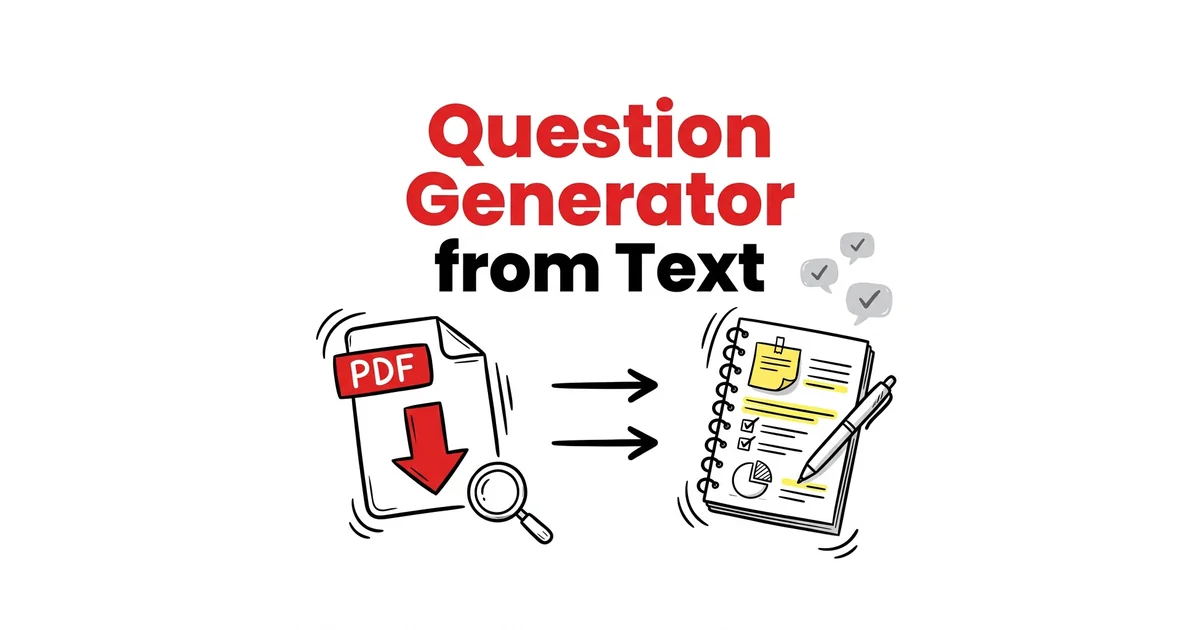
- Input: You copy a section of your textbook, a PDF article, or your own lecture notes, and paste the raw text into the generator.
- Analysis: The AI scans the text, identifying key actors, dates, definitions, causes, and effects. It separates the core thesis from the supporting fluff.
- Output: Within seconds, it generates a list of questions based strictly on the text provided. These can be multiple-choice, true/false, or short-answer questions.
Why This is Highly Effective
By taking a quiz immediately after reading a section of text, you force your brain to perform retrieval practice. You aren't just looking at the information; you are digging it out of your short-term memory. This effort signals to your brain that the information is important, shifting it toward long-term storage.
Furthermore, if you get a generated question wrong, you instantly know that you didn't actually understand the paragraph you just read. This immediate feedback loop is crucial for efficient studying.
The "Read-Test-Read" Workflow
To maximize a question generator, you should integrate it into your daily reading assignments using the Read-Test-Read method.
1. Chunking
Do not try to read a 40-page chapter at once. Break it down into 5-page "chunks" or distinct subsections.
2. The Initial Read
Read the first chunk. Do not highlight. Do not take notes. Just read with the intent to understand the core message.
3. The Instant Test
Copy that 5-page section and paste it into the question generator. Take the generated quiz immediately.
4. The Targeted Re-Read
Review your quiz results. For every question you missed, go back to the text and re-read only the specific paragraph that contains the answer. Use the Feynman Technique to explain the correct answer to yourself out loud.
Repeat this process for the next chunk of text.
Generate Study Materials Instantly with TikoNote
Stop wasting hours making quizzes manually. TikoNote's AI generator instantly creates practice tests, flashcards, and study guides from your PDFs, lecture slides, or raw notes.
👉 Generate your first study guide for free on TikoNote
Frequently Asked Questions
Can I paste an entire textbook into a text generator?
Usually, no. Most tools have a character or word limit per generation to ensure high-quality output. It is also pedagogically better to generate questions on smaller chunks of text (like a single chapter or section) to prevent cognitive overload.
Are the questions too easy?
Early AI generators only asked basic vocabulary questions. Modern AI models can generate complex inference questions, asking you to identify the "main argument" or the "implications" of a text, providing a much deeper level of active recall.
Can I use this for literature or fiction?
Yes, but the results vary. AI is excellent at generating questions on plot points, character actions, and timelines. It struggles slightly more with abstract themes and subjective literary analysis, which are often the focus of English exams.
Conclusion
Reading is only the first step of studying, yet most students treat it as the only step. A question generator from text forces you to take the crucial second step: active retrieval. By instantly converting passive reading assignments into interactive quizzes, you lock in the information, identify your weak spots immediately, and ensure you are actually learning, not just turning pages.
Written by TikoNote Team
AI learning researchers & cognitive science enthusiasts building tools that help students study smarter with evidence-based methods like active recall, spaced repetition, and the Feynman Technique.