
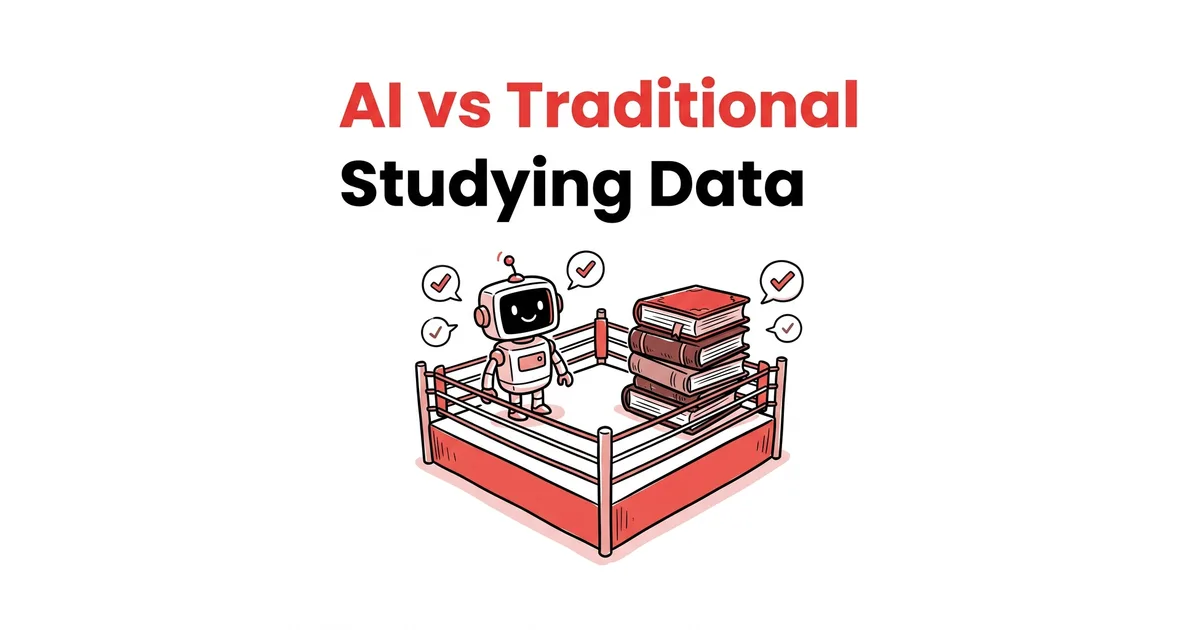
There is a massive debate happening in education right now: does relying on AI make students smarter, or does it make them lazy? In 2026, we finally have enough longitudinal data to answer the question definitively. And the answer is: it entirely depends on how the AI is used.
Let's break down the data comparing traditional study methods against AI-assisted studying.
The Baseline: Traditional Studying is Inefficient
For decades, surveys have shown that the most popular study methods among college students are:
- Re-reading textbook chapters
- Highlighting notes
- Summarizing material
Cognitive psychologists universally agree that these are the least effective methods for long-term retention. They create an "illusion of competence." Because the text looks familiar when you re-read it, your brain tricks you into thinking you've memorized it. You haven't.
The Data: AI as a Crutch vs. AI as a Coach
A landmark 2026 study tracked 5,000 university students across multiple disciplines, splitting them into three groups:
Group 1: Traditional Studying (The Control)
These students used highlighter, paper flashcards they wrote themselves, and re-read their notes. Their average score on the final exam was 72%. They spent an average of 14 hours per week studying outside of class.
Group 2: Passive AI Users (The "Crutch" Group)
These students used AI primarily to summarize long readings, generate essays, and explain concepts they didn't want to read. They rarely tested themselves. Their average score on the final exam was 68% (worse than the traditional group). However, they only spent 6 hours per week studying.
The Takeaway: Using AI merely to bypass the hard work of reading leads to worse outcomes. You save time, but you sacrifice mastery.
Group 3: Active AI Users (The "Coach" Group)
These students used AI to generate practice exams from their specific syllabus, create spaced-repetition flashcards, and run Feynman-style tutoring sessions where they had to explain concepts to the AI. Their average score on the final exam was 89%. They spent an average of 9 hours per week studying.
The Takeaway: When AI is used to facilitate active recall and spaced repetition, students achieve vastly superior grades while still saving time compared to traditional methods.
Why Active AI Wins
The data clearly shows that AI's true power isn't in giving you the answers; it's in asking you the right questions.
Traditional active recall is tedious because you have to spend hours writing the practice questions before you can actually practice them. Active AI removes the friction of setup. Apps like TikoNote instantly convert your passive PDFs into rigorous, active quizzes. You spend 100% of your study time actually retrieving information from your brain, which is the only scientifically proven way to strengthen neural pathways.
The Verdict
Traditional studying is dead, but passive AI studying is a trap. The students dominating the curve in 2026 are the ones using AI to aggressively test themselves.
Put this into practice — right now.
Upload a PDF, lecture slide, or YouTube link. TikoNote instantly generates quizzes, flashcards, and a Feynman session from your own material — not generic internet content.
- ✓ Works on any PDF, video, or audio
- ✓ Active recall built-in — not passive summaries
- ✓ Used by 50,000+ students
Written by TikoNote Team
AI learning researchers & cognitive science enthusiasts building tools that help students study smarter with evidence-based methods like active recall, spaced repetition, and the Feynman Technique.