
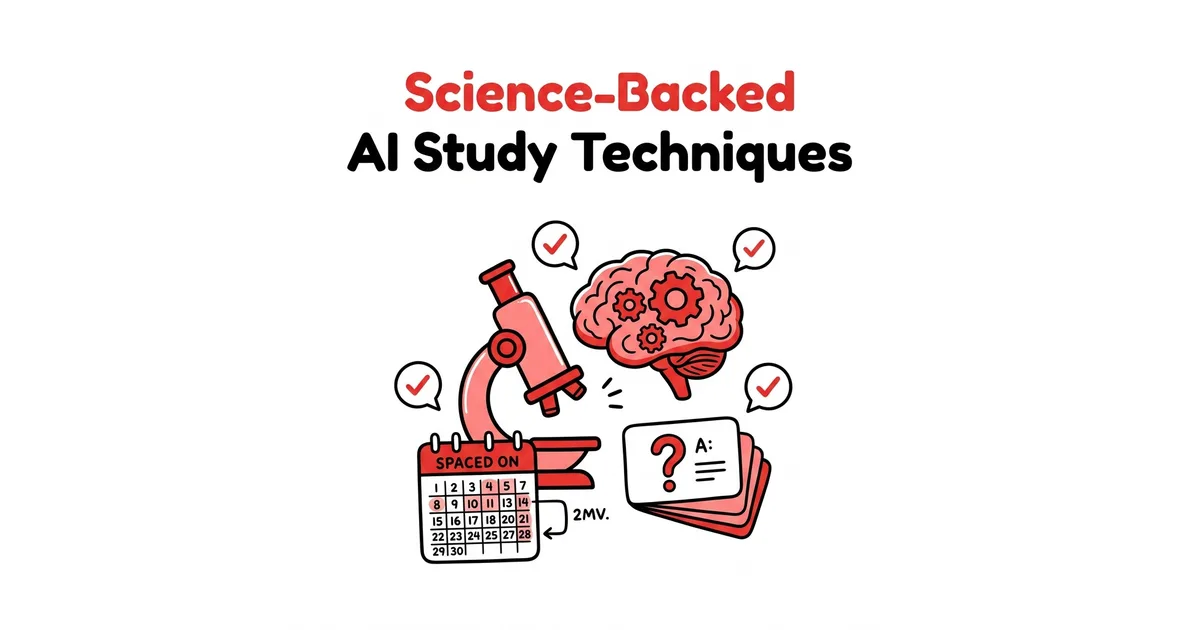
The gap between how students actually study and how cognitive science says they should study has always been massive. For decades, researchers have known that reading textbooks and highlighting notes are among the least effective ways to learn. Yet, they remained the default methods because the alternative—creating hundreds of flashcards or finding someone to test you—was incredibly time-consuming.
In 2026, AI has completely eliminated that friction. We can now perfectly map evidence-based learning principles to instant AI workflows.
1. Active Recall on Demand
Active recall is the process of actively stimulating your memory for a piece of information, rather than passively reviewing it. Instead of re-reading a chapter on cellular respiration, you close the book and try to explain it from scratch.
The AI Workflow: Upload your lecture slides (PDF) to an AI study tool like TikoNote and ask it to generate a rigorous 20-question quiz. By forcing your brain to retrieve the answers rather than just recognizing them on a page, you strengthen the neural pathways associated with that knowledge.
2. Spaced Repetition Without the Setup
The Ebbinghaus Forgetting Curve shows that we forget information at a predictable rate unless we review it at strategically spaced intervals. Spaced repetition algorithms (like those used in Anki) are brilliant, but creating the cards manually takes hours.
The AI Workflow: AI can now extract every key entity, date, formula, and concept from your syllabus and automatically format them into a spaced repetition deck. You spend zero minutes doing data entry and 100% of your time actually reviewing.
3. The Feynman Technique via AI Tutor
Named after the Nobel Prize-winning physicist Richard Feynman, this technique involves explaining a complex concept in plain English as if teaching it to a beginner. If you stumble, you've found a gap in your knowledge.
The AI Workflow: Open an AI voice chat or text prompt and say, "Act as a 10-year-old student. I am going to teach you about macroeconomic inflation. Ask me simple 'why' questions if anything I say is too complicated or uses jargon." The AI will brutally expose the areas where you are hiding behind buzzwords instead of true comprehension.
4. Interleaved Practice
Instead of studying one topic (e.g., only geometry) for hours, interleaving involves mixing different topics or problem types together. This teaches your brain not just how to solve a problem, but how to identify which strategy to use when confronted with a random question.
The AI Workflow: Ask your AI tutor to generate a mock exam that pulls questions randomly from weeks 1 through 6 of your course, mixing multiple-choice, short-answer, and applied problem-solving questions. This perfectly simulates the unpredictability of a real exam.
Conclusion
The magic of AI isn't that it learns for you. It's that it removes the administrative burden of setting up optimal study environments. By combining AI with these four science-backed techniques, you can literally cut your study time in half while doubling your retention.
Put this into practice — right now.
Upload a PDF, lecture slide, or YouTube link. TikoNote instantly generates quizzes, flashcards, and a Feynman session from your own material — not generic internet content.
- ✓ Works on any PDF, video, or audio
- ✓ Active recall built-in — not passive summaries
- ✓ Used by 50,000+ students
Written by TikoNote Team
AI learning researchers & cognitive science enthusiasts building tools that help students study smarter with evidence-based methods like active recall, spaced repetition, and the Feynman Technique.