
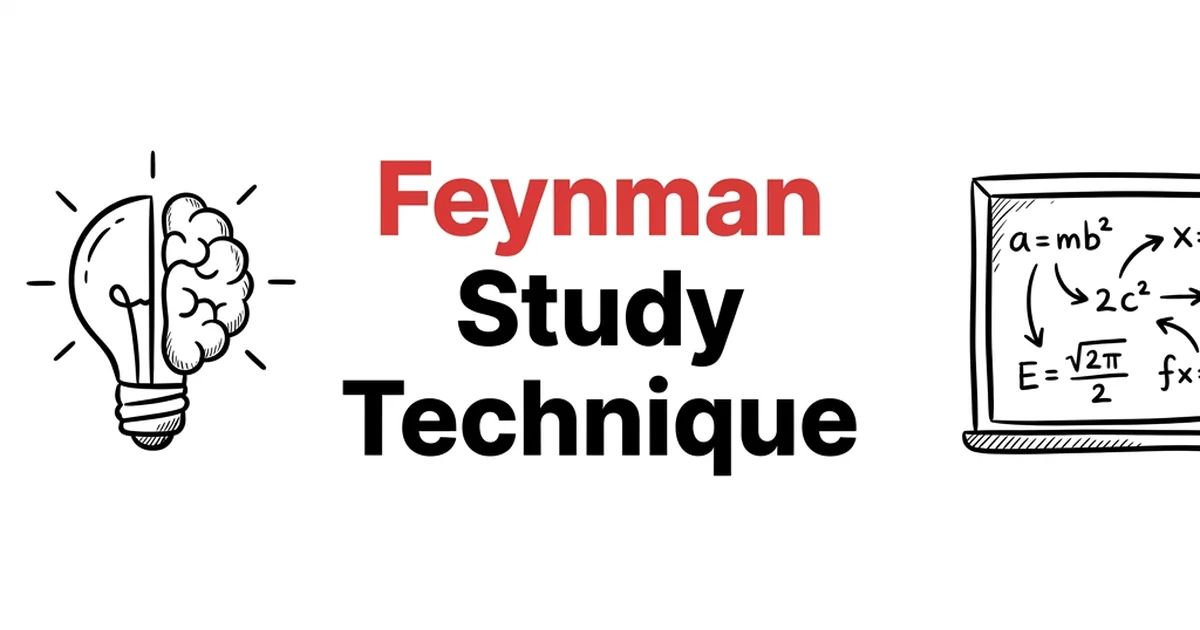
The Feynman Study Technique: How to Master Any Topic in 4 Steps
The Feynman study technique is a four-step learning method where you explain a concept in plain language as if teaching it to a beginner, identify gaps in your explanation, study those specific gaps, and then simplify your explanation further using analogies. Named after Nobel Prize-winning physicist Richard Feynman, it's the single most effective method for building deep conceptual understanding.
Here's why it works: you can't explain something simply if you don't actually understand it. Most study methods let you hide behind jargon and recognition. The Feynman technique strips that away. If you stall while explaining, you've found exactly what you need to study.
This guide covers the exact 4-step process, how to apply it to any subject, and how to combine it with other techniques for maximum results.
The 4 Steps of the Feynman Study Technique
Step 1: Choose One Concept
Pick a single, specific concept. Not a chapter. Not a topic. One concept.
Examples:
- "How does photosynthesis convert light to glucose?"
- "What causes inflation in an economy?"
- "Why does Newton's Third Law always produce equal and opposite forces?"
Write it at the top of a blank page. The specificity matters — broad topics produce vague explanations that feel right but aren't.
Step 2: Explain It in Plain Language
Write out your explanation as if you're teaching someone who has zero background in the subject. Use simple words. Define any technical term you use. Draw diagrams if it helps.
Critical rule: Don't look at your notes. Write only from what's in your head.
This is where the learning happens. Most students discover they can write 2–3 sentences and then stall. That stalling is the most valuable part of the technique — it reveals the exact boundary between what you know and what you merely recognize.
A landmark study by Roediger & Karpicke (2006) demonstrated that this kind of retrieval effort produces 50% better long-term retention than re-reading the same material.
Step 3: Identify Gaps and Go Back to Source
Wherever your explanation broke down — wherever you used vague language, hand-waved over details, or just stopped — those are your knowledge gaps.
Go back to your textbook, lecture notes, or primary source. Study only those gaps. Not the whole chapter. Not everything. Just the parts you couldn't explain.
This is what makes the Feynman technique ruthlessly efficient. Instead of reviewing everything equally, you're targeting the exact points of confusion.
Step 4: Simplify and Use Analogies
Rewrite your explanation. This time, use an analogy to connect the concept to something familiar:
- "Inflation is like adding water to juice — you still have the same amount of real value, but each unit is diluted."
- "Newton's Third Law is like pushing against a wall on roller skates — you push the wall, but the wall pushes you back equally, which is why you roll backward."
Analogies reveal whether you truly understand the underlying mechanism or are just reciting a definition. They also create memorable mental hooks that last far longer than abstract descriptions.
Why the Feynman Technique Works: The Science
The Feynman technique combines three of the most powerful learning strategies identified by Dunlosky et al. (2013):
| Strategy | What It Does | Feynman Step |
|---|---|---|
| Retrieval practice | Forces you to recall information from memory | Step 2 (explain without notes) |
| Elaborative interrogation | Asks "why" and "how" to deepen processing | Step 4 (analogies and simplification) |
| Self-explanation | Makes you articulate reasoning, not just facts | Steps 2–4 (entire process) |
These three strategies are rated "high utility" by the research — meaning they produce the largest learning gains per time invested. The Feynman technique combines all three in a single process.
The Honest Mirror Effect
Re-reading, highlighting, and summarizing all have a fundamental flaw: they create the illusion of understanding. You see familiar words and your brain says "I know this" — but on exam day, recognition fails because it was never true understanding.
The Feynman technique is an honest mirror. You either can explain it or you can't. There's no middle ground, no self-deception. That honesty is uncomfortable but extremely productive.
Applying the Feynman Technique to Different Subjects
STEM (Math, Physics, Chemistry, Biology)
Focus on mechanisms and processes. Don't just explain what happens — explain why it happens. Can you explain why the quadratic formula produces two solutions? If not, that's your gap.
Example Feynman prompt: "Explain how a buffer solution maintains pH when acid is added."
Humanities (History, Literature, Philosophy)
Focus on causal chains and arguments. Why did one event lead to another? What's the author's argument, and what evidence supports it?
Example Feynman prompt: "Explain why the Treaty of Versailles contributed to World War II."
Languages
Explain grammar rules in your native language. If you can't explain when to use the subjunctive in Spanish, you'll keep making the same mistakes.
Example Feynman prompt: "Explain the difference between ser and estar in Spanish."
For a deeper guide, see How to Apply the Feynman Technique to Any Subject.
Feynman Technique + Other Study Methods
The Feynman technique is most powerful when combined with complementary methods:
Feynman + Active Recall
Use active recall to identify which concepts to Feynman. Take a practice quiz first. The questions you get wrong are the concepts you should Feynman next.
Feynman + Spaced Repetition
Feynman a concept once to understand it deeply. Then use spaced repetition to maintain that understanding over time. Re-Feynman at increasing intervals: Day 3, Day 7, Day 14.
Feynman + Mind Maps
Create a mind map of a topic first to see the big picture. Then Feynman individual branches — starting with the ones you struggled to map. This progression from overview to deep-dive is highly efficient.
For a direct comparison, see: Feynman Technique vs Spaced Repetition
Common Mistakes Students Make
Mistake 1: Going back to notes too quickly. The discomfort of not knowing is the point. Sit with the struggle for at least 5 minutes before looking anything up. The effort of trying to recall strengthens the memory even when you fail.
Mistake 2: Using jargon without defining it. If your explanation includes "mitosis," "amortization," or "photon" without a plain-language definition, you haven't simplified enough.
Mistake 3: Covering too much at once. One concept per session. The technique loses its power when you try to Feynman an entire chapter.
Mistake 4: Skipping the analogy step. Analogies are how concepts move from abstract understanding to durable memory. Don't skip them.
Try the Feynman Technique with AI — In Your Own Notes
Explaining concepts back is the core of the Feynman method. TikoNote's AI Feynman Tutor does exactly that — it reads your notes and asks you to explain key concepts in plain language, then gives instant feedback on gaps in your understanding.
👉 Try TikoNote free — no credit card required
Frequently Asked Questions
How long does the Feynman technique take per concept?
One focused session takes 20–40 minutes per concept. That's far more efficient than 3 hours of passive re-reading that produces minimal retention. Quality over quantity — one Feynman session builds more understanding than multiple re-reading sessions.
Is the Feynman technique better than flashcards?
For conceptual understanding, yes. Flashcards excel at isolated facts (vocabulary, dates, formulas). The Feynman technique excels at understanding how and why things work. The best approach uses both: Feynman for comprehension, flashcards with spaced repetition for retention.
Can I use the Feynman technique for math?
Absolutely — it's especially powerful for math. Most students memorize formulas without understanding derivations. The Feynman technique forces you to explain why a formula works, which makes it far harder to confuse or forget under exam pressure.
What if I can't explain something even after studying?
That's normal and valuable. It means the concept is genuinely complex. Break it into smaller sub-concepts and Feynman each one separately. Complex ideas are made of simpler ideas stacked together — Feynman the stack layer by layer.
How is this different from the regular Feynman Technique article?
This article focuses on the Feynman study technique — how to integrate it into your study workflow, combine it with other methods, and apply it across different subjects. For the foundational overview, see What Is the Feynman Technique?
Try the AI-Powered Feynman Tutor
Want to apply the Feynman Technique with instant AI feedback? TikoNote's Feynman AI tutor asks you to explain concepts in your own words, detects gaps in your understanding, and guides you to mastery. Upload any PDF or notes and start a Feynman session in seconds.
👉 Try Feynman AI free — no signup required
The Bottom Line
The Feynman study technique works because it's honest. It exposes the gap between recognition and understanding — and then gives you a systematic way to close that gap. Every concept you can explain simply is a concept you truly own.
Your action step for today: Pick one concept from your current course. Open a blank document. Write the concept name at the top. Explain it in plain language without looking at your notes. Where you stall is where you start studying. That 20-minute exercise will teach you more than 2 hours of re-reading.
Put this into practice — right now.
Upload a PDF, lecture slide, or YouTube link. TikoNote instantly generates quizzes, flashcards, and a Feynman session from your own material — not generic internet content.
- ✓ Works on any PDF, video, or audio
- ✓ Active recall built-in — not passive summaries
- ✓ Used by 50,000+ students


Written by TikoNote Team
AI learning researchers & cognitive science enthusiasts building tools that help students study smarter with evidence-based methods like active recall, spaced repetition, and the Feynman Technique.