
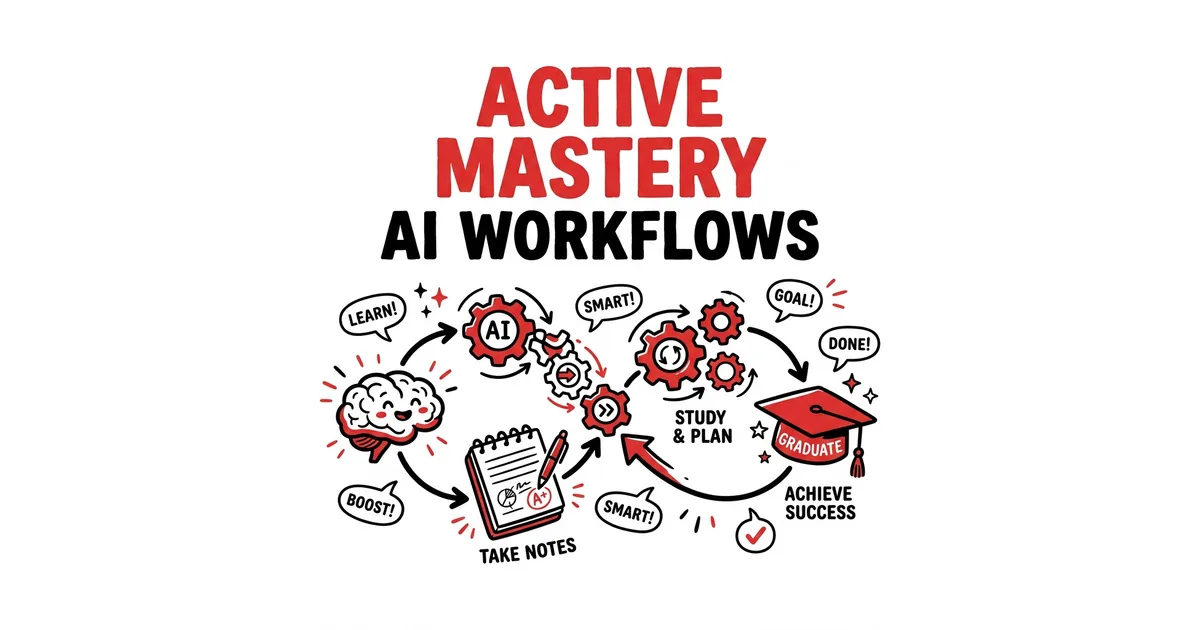
There is a massive difference between "studying" and "mastery." Studying is often passive: reading, highlighting, hoping the information sticks. Mastery is active: building mental models, stress-testing your knowledge, and proving to yourself that you understand the material from every angle.
In 2026, the highest-performing students don't just use AI to summarize texts. They use it to execute a specific, 3-step loop called the Active Mastery Workflow. Here is how you implement it.
Step 1: The Priming Phase (AI as Scanner)
Before you ever read a dense textbook chapter or attend a complex lecture, you need to prime your brain. Priming gives your brain a scaffolding to attach new information to.
The Action: Take your syllabus or the upcoming chapter title and feed it into your AI tool. Ask it: "Give me a 300-word overview of [Topic], highlight the 5 most important vocabulary words I need to know, and explain why this topic matters in the broader context of the course."
The Result: When you walk into the lecture or open the book, you aren't overwhelmed by details. You already know the structure of the forest, so you can focus on studying the trees.
Step 2: The Encoding Phase (AI as Interrogator)
This is where 90% of traditional studying fails. Students read their notes and think they are done. Instead, you need to aggressively encode the information through Active Recall.
The Action: Immediately after the lecture, upload your notes or the slide deck into an app like TikoNote. Do not ask for a summary. Ask it to generate a 15-question quiz (a mix of multiple-choice and short-answer). Close your notes. Take the quiz.
The Result: You will get several questions wrong. This is the goal! Getting questions wrong signals to your brain that this information is weak. The AI will instantly explain your mistakes, cementing the correct information in your memory far better than re-reading ever could.
Step 3: The Synthesis Phase (AI as Skeptic)
Memorizing facts is enough for a B. Synthesizing concepts is required for an A. You need to prove you can apply the knowledge.
The Action: Use the "Blurting" technique combined with an AI Tutor. Open a blank page and write down everything you know about the topic from memory. Feed that text to the AI and say: "This is my understanding of [Topic]. Act as a strict professor. Point out any logical flaws, missing connections, or areas where my understanding is superficial."
The Result: The AI will ruthlessly expose the gaps in your mental model. It might say, "You explained the process of mitosis well, but you failed to mention the role of spindle fibers, which is critical." You now know exactly what to review for the final 10 minutes of your study session.
The Workflow in Practice
This 3-step loop—Prime, Encode, Synthesize—takes less time than reading a chapter three times with a highlighter. However, it requires significantly more mental effort. It feels harder because it actually works.
Stop using AI to make studying "easy." Use AI to make the right kind of difficult studying highly efficient.
Put this into practice — right now.
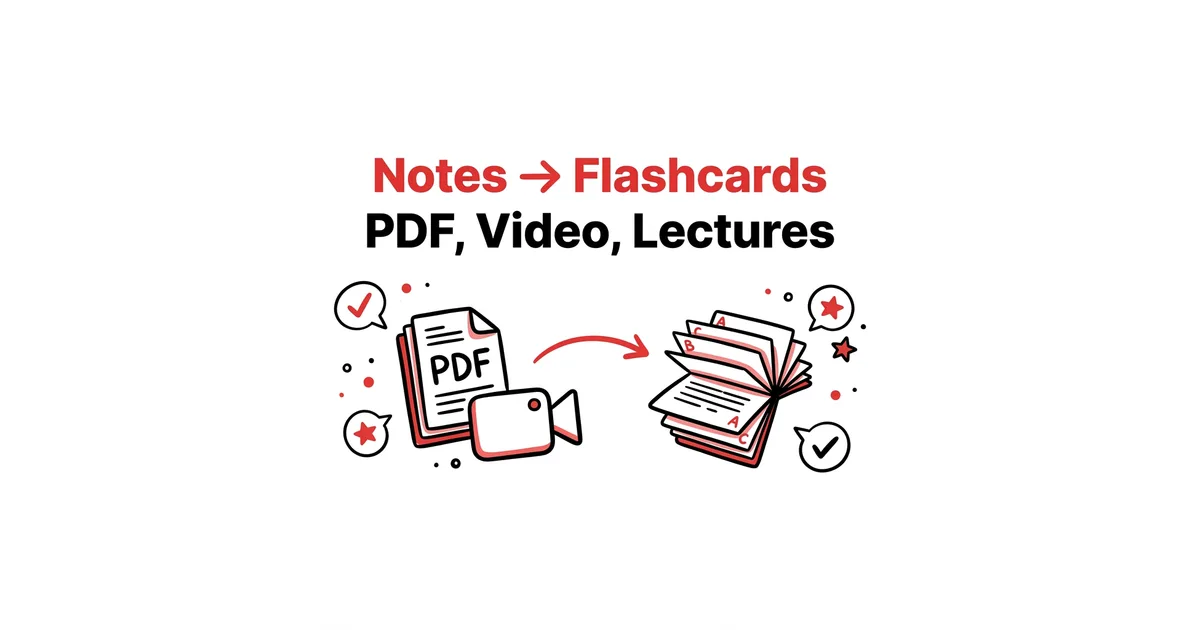
Upload a PDF, lecture slide, or YouTube link. TikoNote instantly generates quizzes, flashcards, and a Feynman session from your own material — not generic internet content.
- ✓ Works on any PDF, video, or audio
- ✓ Active recall built-in — not passive summaries
- ✓ Used by 50,000+ students
Written by TikoNote Team
AI learning researchers & cognitive science enthusiasts building tools that help students study smarter with evidence-based methods like active recall, spaced repetition, and the Feynman Technique.