
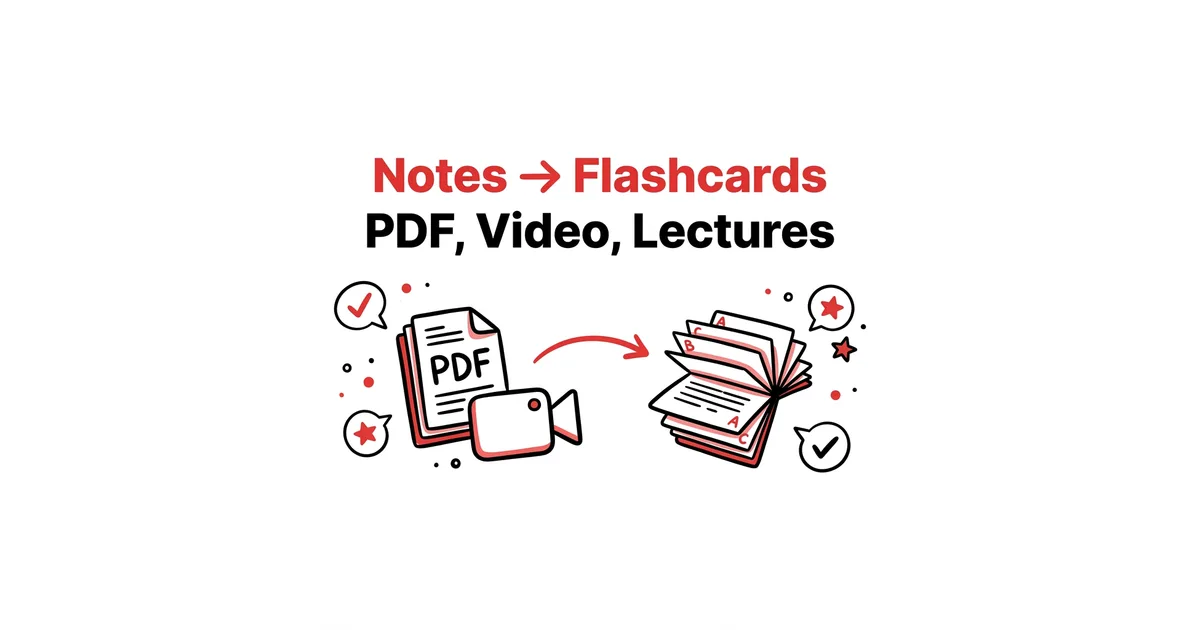
We've all been there: it's 10 PM, the exam is in three days, and you're staring at a 40-page PDF of dense lecture slides. You know you need to memorize the key terms, but the thought of manually typing out 150 flashcards is soul-crushing.
The good news? In 2026, manual flashcard creation is obsolete. Here is the definitive guide to automating the process using AI, regardless of the format your materials are in.
Transforming PDFs and Slides
Text-based documents are the easiest for AI to process. Tools like TikoNote allow you to upload your professor's exact slide deck or a textbook chapter.
- The Strategy: Don't just ask for "flashcards." Be specific. Prompt the AI: "Extract every bolded term, key historical figure, and date from this PDF. Format the front of the card as a question or fill-in-the-blank, and the back as a concise answer."
- Why it works: Fill-in-the-blank (cloze deletion) cards are often faster to review and prevent you from memorizing the "shape" of an answer without understanding the concept.
Converting YouTube Lectures and Zoom Recordings
Video is traditionally the hardest format to study from because it's unsearchable and passive. AI changes this by processing the transcript.
- The Strategy: Paste the YouTube URL or upload the Zoom recording into your AI study app. Instruct it to: "Act as a diligent medical student. Watch this lecture on the cardiovascular system and create flashcards for every disease mechanism mentioned."
- The benefit: The AI ignores the instructor's tangents and small talk, isolating only the testable material.
Turning Messy Handwritten Notes into Digital Decks
If you prefer taking notes by hand (which is actually great for initial memory encoding), you don't have to sacrifice the benefits of digital flashcards.
- The Strategy: Use your phone to snap photos of your notebook. Modern Optical Character Recognition (OCR) combined with Vision AI can read even terrible handwriting. The AI will parse your scrawls, fix your spelling mistakes, and structure the messy diagrams into Q&A formats.
The Golden Rule of AI Flashcards
Always review the generated cards before studying them. AI is incredible at extraction, but it doesn't know what your professor emphasized in class. Delete the cards that are too obvious, split the ones that are too complex, and add any specific nuances you remember from the lecture.
By automating the creation process, you save hours of busywork—time you can now spend actually doing the spaced repetition that guarantees an A.
Put this into practice — right now.
Upload a PDF, lecture slide, or YouTube link. TikoNote instantly generates quizzes, flashcards, and a Feynman session from your own material — not generic internet content.
- ✓ Works on any PDF, video, or audio
- ✓ Active recall built-in — not passive summaries
- ✓ Used by 50,000+ students
Written by TikoNote Team
AI learning researchers & cognitive science enthusiasts building tools that help students study smarter with evidence-based methods like active recall, spaced repetition, and the Feynman Technique.