
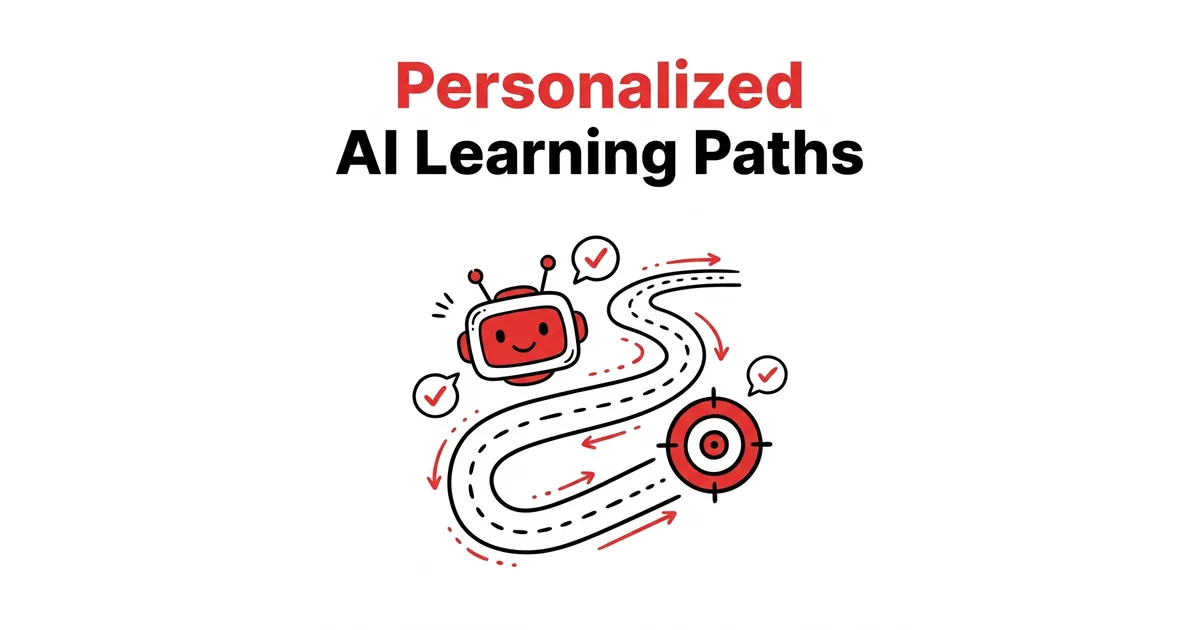
For the last century, education has been a one-size-fits-all model. Thirty students sit in a room, listen to the exact same lecture, read the exact same textbook chapter, and take the exact same test. If you didn't understand Step 2 of the math equation, you were still dragged along to Step 3 because the syllabus demanded it.
AI has fundamentally broken this model by introducing true adaptive, personalized learning paths at scale.
The Death of the Static Study Guide
Traditional study guides outline everything that might be on the test. They treat you as a blank slate. An AI tutor treats you as an individual with a specific, unique map of knowledge gaps.
When you start a session with a modern AI study app, it doesn't just hand you a list of facts. It runs a diagnostic. By asking you three to five probing questions, it instantly maps what you already know against what you need to know. It then builds a learning path that focuses only on your weaknesses.
How Real-Time Adaptation Works
Imagine you are studying the French Revolution. A generic guide says: "Memorize the causes, the Reign of Terror, and the rise of Napoleon."
An AI tutor operates differently:
- The Probe: It asks you to summarize the economic causes of the revolution.
- The Assessment: You mention the bread shortages but completely forget about France's massive debt from the American Revolution.
- The Pivot: Instead of moving on to the Reign of Terror, the AI pauses. It generates a mini-lesson specifically about King Louis XVI's financial crisis, followed by a quick check-for-understanding question.
- The Progression: Only once you prove you understand the debt crisis does it allow you to move forward to the next historical era.
The "Zone of Proximal Development"
Psychologist Lev Vygotsky coined the term "Zone of Proximal Development" (ZPD) to describe the sweet spot of learning: material that is just slightly too hard for a student to do independently, but achievable with a little guidance. If material is too easy, the student is bored. If it's too hard, they are frustrated.
Human teachers struggle to keep 30 students in their individual ZPDs simultaneously. AI does it effortlessly. If you are breezing through biology flashcards, the AI automatically increases the difficulty, asking you to synthesize concepts rather than just define terms. If you are struggling with a physics formula, it dials back the complexity, breaking the math down into smaller, foundational steps.
The Result: Radical Efficiency
By constantly pruning away what you already know and hyper-focusing on your specific gaps, personalized AI paths reduce total study time by an estimated 40% while dramatically improving mastery. You aren't just learning faster; you're learning better.
Put this into practice — right now.
Upload a PDF, lecture slide, or YouTube link. TikoNote instantly generates quizzes, flashcards, and a Feynman session from your own material — not generic internet content.
- ✓ Works on any PDF, video, or audio
- ✓ Active recall built-in — not passive summaries
- ✓ Used by 50,000+ students
Written by TikoNote Team
AI learning researchers & cognitive science enthusiasts building tools that help students study smarter with evidence-based methods like active recall, spaced repetition, and the Feynman Technique.