
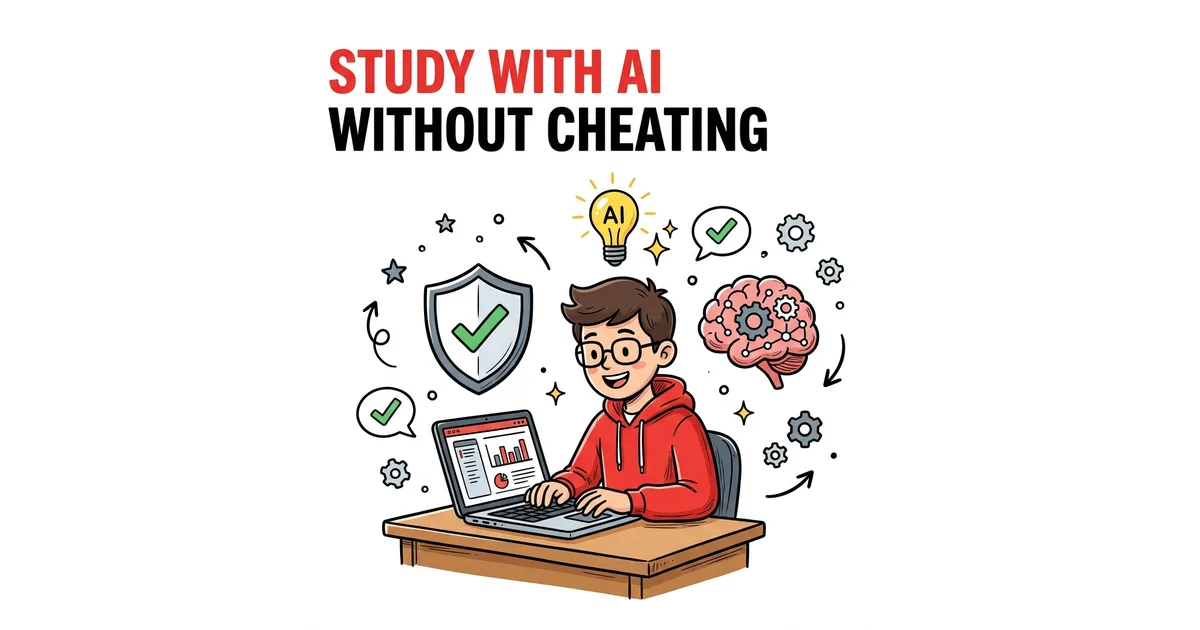
Every student using AI for studying in 2026 is navigating the same uncomfortable question: where exactly is the line? Reading an AI summary of your lecture notes — fine, probably. Pasting an essay prompt into ChatGPT and submitting the output — obviously not. But there are fifty shades of grey in between, and most universities are providing zero guidance on where each shade falls.
This guide will give you a clear, practical framework for using AI in ways that genuinely improve your learning without compromising your academic integrity or — more importantly — your ability to actually think.
First: Why "Don't Cheat" Is the Wrong Framing
Framing AI ethics purely as a cheating conversation misses the bigger risk. The more important question isn't "will my professor catch this?" It's "am I actually learning anything?"
Cognitive science has a term for it: cognitive offloading. When you outsource mental work to a tool — writing notes, making sense of an argument, forming an opinion — you deprive your brain of the practice it needs to do that work independently. Muscles don't grow without resistance. Minds don't either.
The students who will thrive in an AI-saturated world aren't those who use AI the most. They're the ones who use AI to put more cognitive work on their own plate — not less. This distinction is the entire foundation of ethical, effective AI studying.
The Golden Rule: AI as Tutor, Never as Author
Here is the single heuristic that covers 90% of situations:
If AI is generating the thinking you're supposed to submit or demonstrate, you're cheating — yourself and your institution. If AI is prompting, testing, explaining, or challenging your thinking, you're studying.
Let's make that concrete with specific use cases.
What AI Should Do: The Green List
1. Generate Practice Questions From Your Notes
Upload your lecture PDF or notes to an AI study tool and ask it to generate 20 multiple-choice questions on the material. Then close the notes and answer them from memory. This is active recall — the single most evidence-backed study technique in cognitive psychology. The AI is doing the question-writing; you're doing the thinking.
TikoNote does this automatically — upload a PDF and get a full quiz set grounded entirely in your own material, not generic internet content.
2. Create Flashcards for Spaced Repetition
Having AI generate flashcards from your lecture slides saves time on card creation — which is not the learning part anyway. The learning happens when you actually review them with spaced repetition. AI speeds up the setup; you do the retrieval work.
3. Get Explanations When Stuck
"Explain the mechanism of action of beta-blockers in simple terms" is a perfectly legitimate use of an AI tutor. It's what you'd do with a knowledgeable friend or a tutoring service. The key: once you understand it, explain it back in your own words. Don't just re-read the AI's explanation and move on.
4. Run a Feynman Session
Ask an AI to act as a skeptical student while you teach it a concept. "Challenge me on anything I say that's incorrect or superficial." This forces you to explain, defend, and deepen your understanding — exactly what the Feynman Technique is designed to do. The AI isn't generating your knowledge; it's testing whether you actually have any.
5. Check Your Understanding, Not Your Work
After writing a paragraph or solving a problem yourself, you can ask AI: "What are the common misconceptions about this topic?" or "What would a strong counterargument be?" Use the response to stress-test your thinking — not to rewrite what you produced.
6. Summarize to Launch, Not to Finish
Using AI to give you a three-paragraph overview of a topic before you read the primary source is a legitimate study technique — it primes your brain for the detail to come. Using AI to summarize a reading instead of doing the reading is substitution, not studying.
What AI Should Not Do: The Red List
1. Write Your Essays or Assignments
This one is obvious — but the subtle version is just as harmful. "I wrote this paragraph, can you improve it?" sounds harmless. But if the AI substantially rewrites your logic, structure, and language, what you submit isn't yours. The test of whether you've crossed the line: could you explain and defend every sentence if asked? If not, you've gone too far.
2. Answer Exam Questions on Your Behalf
Feeding exam questions into AI during a timed assessment is straightforward cheating. This includes open-book exams where AI use is not explicitly permitted. If the assessment is designed to test your knowledge, using AI to generate the answer subverts the entire point.
3. Replace the Primary Source
AI summaries of academic papers, textbooks, or case law are not a substitute for reading them. They compress, simplify, and sometimes subtly distort. In subjects that require you to engage critically with primary sources — law, medicine, history, philosophy — AI summaries are a starting scaffold, not a destination.
4. Generate Data or Citations You Haven't Verified
AI hallucination is a well-documented problem. Pasting AI-generated statistics or citations into an essay without checking them against actual sources is academically reckless, regardless of your institution's AI policy. Always verify.
How to Protect Your Critical Thinking
Here is a set of habits that keep your cognitive muscles strong even as you use AI tools heavily:
- The explain-back rule: After any AI explanation, close the tab and write or say the same concept in your own words. If you can't, you didn't understand it — you just read it.
- The first-draft rule: Always produce a first attempt at any problem, question, or piece of writing before consulting AI. Even if it's rough, you've exercised the thinking circuits first.
- The question-to-answer ratio: Track how often you use AI to ask questions versus how often you use it to get answers to paste somewhere. Healthy AI use is question-heavy.
- Blurting before checking: Before reviewing AI-generated notes or summaries, spend 5 minutes writing everything you can remember about the topic from your own head. Then compare. The gap is what you need to study.
What to Do When You're Unsure If Something Is Allowed
If your institution hasn't published a clear AI policy — and most haven't — use this three-question test:
- Would I be comfortable showing my professor exactly how I used AI here? If not, don't do it.
- Am I learning something through this process, or am I bypassing the learning? Bypassing = stop.
- If the AI disappeared tomorrow, would I be able to do this myself? If you've been using AI to substitute for building that skill — not to accelerate building it — that's the problem.
When genuinely uncertain, email your professor. Most faculty will respect a student who asks in good faith more than they respect one who assumes permission they were never given.
How TikoNote is Designed for Ethical AI Study
TikoNote was built specifically around the active-learning model — where AI generates the questions and prompts, and the student does the retrieval and explanation work.
- Quizzes and flashcards are generated from your files — so every question is grounded in material your professor assigned, not generic internet content.
- Blurting mode asks you to brain-dump everything you remember, then scores your recall — you can't outsource this to AI. The thinking is entirely yours.
- Feynman AI Tutor tests whether you can explain topics in your own words and challenges gaps — it's explicitly designed to put cognitive work on you, not remove it.
- There's no "write my essay" feature, by design.
The goal is a tool that makes you better at your own thinking — not one that replaces it.
A Note on Academic Integrity Policies in 2026
The policy landscape is a mess, and that's not the student's fault. As of Q1 2026, only 28% of universities had published comprehensive AI use policies. The rest left students in a grey area — which predictably led to both over-caution (students refusing to use AI tools that are legitimate) and under-caution (students assuming anything goes).
If your institution is in the 72%, this guide represents a conservative, defensible approach: use AI as a tutor and tester, never as an author or answerer. You'll be on solid ethical ground regardless of what the eventual policy says.
FAQ
Is using AI for studying cheating?
Not by default. Using AI to generate practice questions, explain concepts, create flashcards, or run tutoring sessions is legitimate studying. Using AI to write assignments or answer exam questions on your behalf is cheating. The line is whether AI is doing the thinking you're supposed to demonstrate.
What is cognitive offloading and why is it a risk?
Cognitive offloading is when you delegate mental work to an external tool — like asking AI to summarize a reading instead of working through it yourself. Done habitually, it prevents you from building the comprehension, analysis, and problem-solving skills the course is designed to develop.
Can AI help with exam revision without being unethical?
Yes — if you use it for active recall. Upload your lecture notes to a study AI, generate a quiz, close your notes, and answer from memory. That's ethical, evidence-backed revision. The AI wrote the questions; you're doing the retrieval work.
What should I do if my university has no AI policy?
Apply the transparency test: would you be comfortable showing your professor exactly how you used AI? If yes, proceed. If not, don't. When genuinely uncertain, ask — most faculty appreciate the honesty.
Does using AI make you worse at thinking over time?
It can — if you use it passively. Students who primarily use AI to read summaries and avoid effortful thinking tend to score lower on tasks requiring genuine comprehension. Students who use AI to prompt active recall and self-testing consistently show stronger learning outcomes. The tool doesn't determine the outcome; how you use it does.
Put this into practice — right now.
Upload a PDF, lecture slide, or YouTube link. TikoNote instantly generates quizzes, flashcards, and a Feynman session from your own material — not generic internet content.
- ✓ Works on any PDF, video, or audio
- ✓ Active recall built-in — not passive summaries
- ✓ Used by 50,000+ students
Written by TikoNote Team
AI learning researchers & cognitive science enthusiasts building tools that help students study smarter with evidence-based methods like active recall, spaced repetition, and the Feynman Technique.