
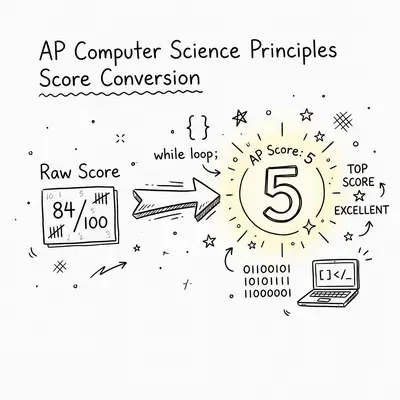
How is the AP Computer Science Principles exam scored?
The AP Computer Science Principles exam consists of multiple sections. Your raw scores from all sections are combined into a composite score out of 100, which is then converted into the final 1–5 AP score using the year's specific curve.
| Section | Format |
|---|---|
| Section I: Multiple Choice | 70 questions (70% weight) |
| Section II: Free Response / Task | Create Task (30% weight) |
What do you need for a 3, 4, or 5?
While the exact cutoffs change every year depending on the difficulty of the specific test form, these are the estimated composite scores required for each AP score.
| AP Score | Composite Points | College Board Meaning |
|---|---|---|
| 5 | 75–100 | Extremely well qualified |
| 4 | 63–74 | Very well qualified |
| 3 | 50–62 | Qualified |
| 2 | 38–49 | Possibly qualified |
| 1 | 0–37 | No recommendation |
Frequently Asked Questions
How is the Create Task graded for AP CSP?▼
The Create Performance Task is evaluated based on a 6-point official rubric that looks at program purpose, algorithms, abstraction, and handling complexity.
Are there guessing penalties on the MCQ?▼
No, there is no penalty for incorrect answers on the multiple-choice section. You should answer every single question.
What score is needed for a 5 on AP CSP?▼
Historically, students who score roughly 75-80% overall (combining the MCQ and Create Task) secure a 5 on the exam.