
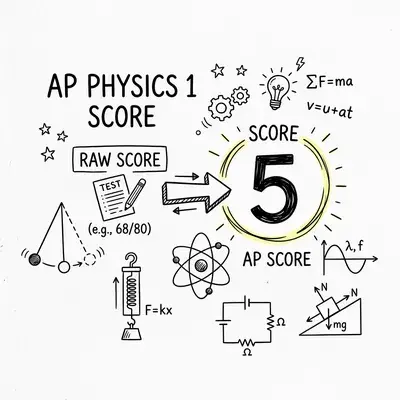
How is the AP Physics 1 exam scored?
The AP Physics 1 exam consists of a multiple-choice section and a free-response section. Your raw scores from both sections are combined into a composite score out of 100, which is then converted into the final 1–5 AP score using the year's specific curve.
| Section | Format |
|---|---|
| Section I: Multiple Choice | 50 questions · 90 minutes (50% weight) |
| Section II: Free Response | 5 questions · 90 minutes (50% weight) |
What do you need for a 3, 4, or 5?
While the exact cutoffs change every year depending on the difficulty of the specific test form, these are the estimated composite scores required for each AP score.
| AP Score | Composite Points | College Board Meaning |
|---|---|---|
| 5 | 70–100 | Extremely well qualified |
| 4 | 55–69 | Very well qualified |
| 3 | 41–54 | Qualified |
| 2 | 27–40 | Possibly qualified |
| 1 | 0–26 | No recommendation |
Frequently Asked Questions
Why is the 5 rate so low for AP Physics 1?▼
AP Physics 1 traditionally has one of the lowest pass rates and 5 rates of any AP exam. This is because it focuses heavily on conceptual understanding and algebraic derivation rather than just plugging numbers into formulas.
Can I use a calculator on AP Physics 1?▼
Yes, a calculator is allowed on the entire exam. However, many questions are conceptual or require you to derive formulas using variables rather than numbers, so a calculator isn't always helpful.
What percentage do I need for a 5 in AP Physics 1?▼
Because the test is difficult, the curve is relatively generous. You typically need around 70% of the total available points to secure a 5.