
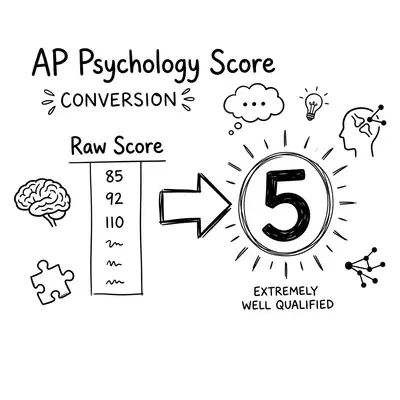
How is the AP Psychology exam scored?
The AP Psychology exam consists of a multiple-choice section and a free-response section. Your raw scores from both sections are combined into a composite score out of 150, which is then converted into the final 1–5 AP score using the year's specific curve.
| Section | Format |
|---|---|
| Section I: Multiple Choice | 100 questions · 70 minutes (66.7% weight) |
| Section II: Free Response | 2 questions · 50 minutes (33.3% weight) |
What do you need for a 3, 4, or 5?
While the exact cutoffs change every year depending on the difficulty of the specific test form, these are the estimated composite scores required for each AP score.
| AP Score | Composite Points | College Board Meaning |
|---|---|---|
| 5 | 113–150 | Extremely well qualified |
| 4 | 93–112 | Very well qualified |
| 3 | 77–92 | Qualified |
| 2 | 65–76 | Possibly qualified |
| 1 | 0–64 | No recommendation |
Frequently Asked Questions
Is AP Psychology an easy AP class?▼
It is generally considered one of the more accessible AP classes, heavily focused on vocabulary and memorization. However, the exam still requires deep application of those concepts.
How is the AP Psychology FRQ graded?▼
FRQs are graded on a point-by-point basis. You must clearly define the psychological term and apply it specifically to the scenario provided in the prompt to earn the point.
What percentage do I need for a 5 in AP Psychology?▼
You typically need to earn around 75% of the total available points (about 113 out of 150 composite points) to score a 5. Since MCQs make up 2/3 of the score, doing well there is crucial.